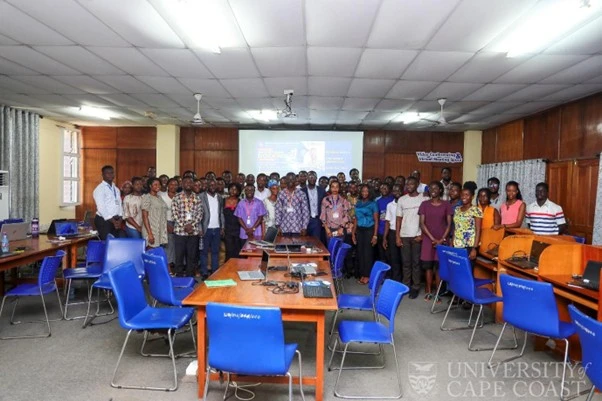
The Department of Chemistry of the University of Cape Coast has organised a three-day intensive training workshop on molecular docking for students and researchers within and beyond its academic community.
The workshop, held at the Sam Jonah Library’s Digital Information Centre, was spearheaded by the MedChem Drug Discovery Research Group of the Department.
The workshop was aimed at equipping participants with solid understanding of the drug discovery pipeline, introducing them to computer-aided drug discovery (CADD) techniques, and providing hands-on training in molecular docking.
Particular emphasis was placed on integrating molecular docking into natural product-based drug discovery, an area of growing importance in addressing disease burdens in Africa and beyond.
The workshop attracted 58 participants, comprising both undergraduate and postgraduate students from diverse academic backgrounds, including Biomedical Sciences, Molecular Biology, Biochemistry, Chemistry, and Pharmaceutical Sciences.
The programme also drew participants from the University of Health and Allied Sciences, Cape Coast Technical University, as well as Chemistry teachers from Senior High Schools.
The training was facilitated by the Principal Investigators of the research group, Prof Isaac Asiamah and Prof Francis Ackah Armah.
Presenting an overview of drug discovery, Prof Isaac Asiamah explained that drug development was a complex, multi-stage process spanning target identification, lead discovery, optimization, clinical trials, and regulatory approval.
He noted that bringing a drug to market typically requires 10 to 12 years of rigorous research and significant financial investment, often accompanied by high attrition rates.
However, he underscored that effective integration of computational tools such as molecular docking can significantly accelerate the discovery process, reduce costs, and improve success rates.
Addressing the workshop, a PhD candidate, Mr. Samuel Asiamah Obiri introduced participants to the activities of the MedChem Drug Discovery Research Group and highlighted the opportunities it offers for student development.
He emphasized the group’s inclusive mentorship model, which spans Level 100 students to PhD candidates.
Participants expressed satisfaction with the workshop, citing its practical relevance, interactive format, and the opportunity to engage with experienced researchers and peers from the MedChem Drug Discovery Research Group. The initiative aligns with the university’s commitment to advancing research capacity, fostering innovation, and promoting interdisciplinary collaboration in science and technology.
The MedChem Drug Discovery Research Group reaffirmed its commitment to supporting participants beyond the workshop through mentorship and collaborative research opportunities to strengthen drug discovery research in Ghana.
The workshop was supported by PhD students: Samuel Asiamah Obiri, Evans Akimat (international student from Kenya), and Mohamed Alkhair (international student from Sudan).
Two MPhil students in the research group, Obed Adarkwah Yiadom and Isaac Andorful, also served as facilitators.
Source: Documentation and Information Section-UCC