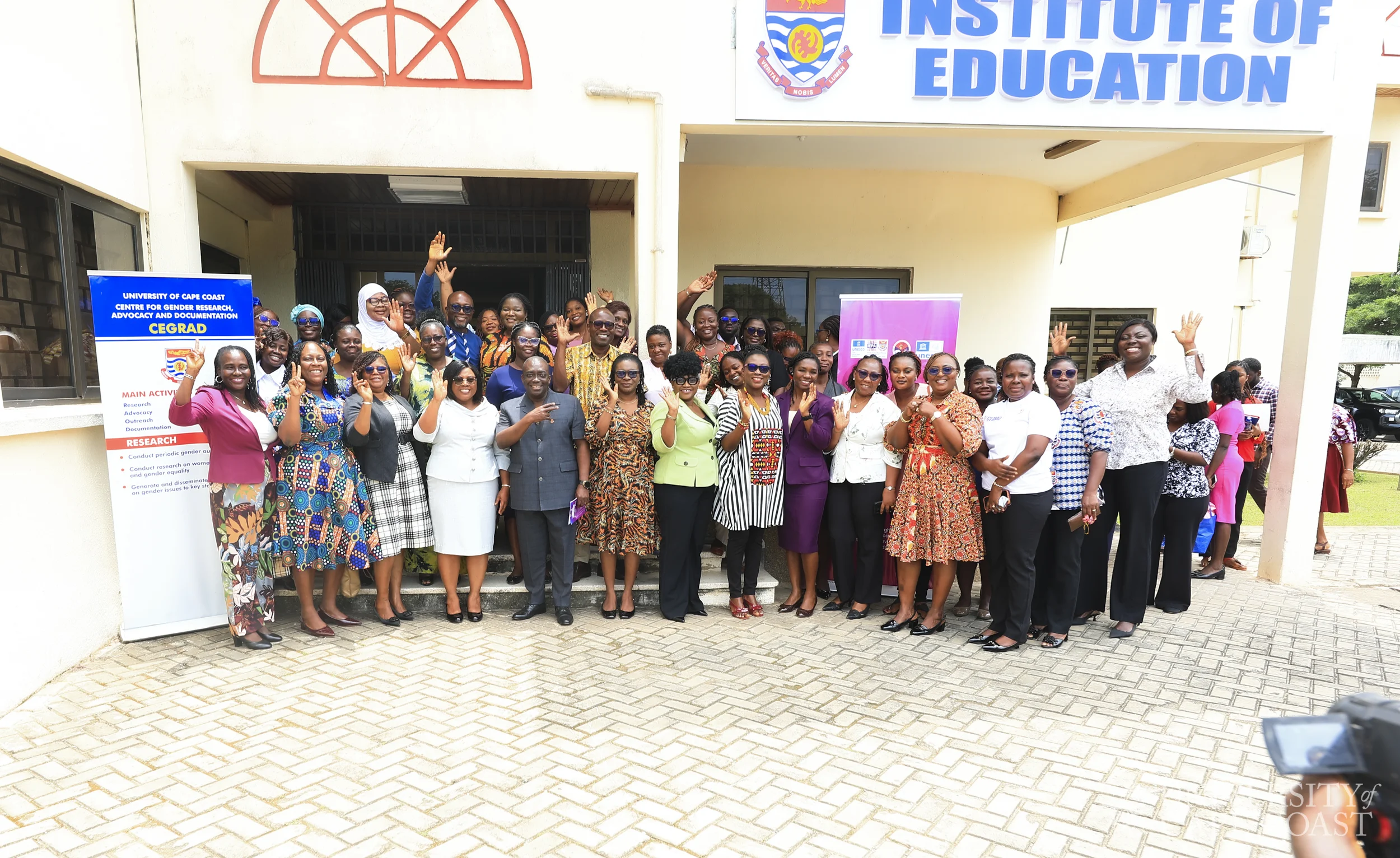
The University of Cape Coast (UCC) has taken a significant step towards advancing women’s participation in digital transformation and educational leadership with the launch of the Women Leading Change (WLC) in Africa programme.
The Institute for Educational Planning and Administration (IEPA), a UNESCO Category II Centre of Excellence at UCC, in partnership with the Centre for Gender Research, Advocacy and Documentation (CEGRAD), is implementing the initiative in close collaboration with the International Centre for Higher Education Innovation under the auspices of UNESCO (UNESCO-ICHEI) and the UNESCO Institute for Information Technologies in Education (UNESCO IITE).
The WLC programme is a landmark initiative aimed at systematically bridging the digital and Artificial Intelligence (AI) competency gaps for female educators and institutional leaders across Ghana. The fully funded programme seeks to train 1, 000 higher education professionals between August 2026 and November 2027, with a spotlight on female faculty members and administrative professionals in higher education, as well as those in pre-tertiary institutions. It will consist of two in-person training cohorts culminating in an executive policy dialogue in 2027.
The hybrid launch brought together academics, pre-tertiary and higher education educators, university administrators and other key stakeholders.
In his opening address, the Director of IEPA, Prof. Michael Boakye-Yiadom, emphasised the urgent need to empower female academics and educational leaders as AI and other emerging technologies continue to reshape the global education landscape.
He noted that despite the rapid advancement of digital technology, women continue to encounter structural barriers that limit their participation and progression in leadership. He said the programme was designed to build the capacity of women.
Prof. Boakye-Yiadom explained that the initiative seeks to promote an Afrocentric approach to leadership that recognizes Africa’s own history, values and experiences while preparing women to respond effectively to contemporary technological challenges.
The Director of CEGRAD, Prof. Eunice Fay Amissah, reinforced the vision of the programme with a call for women to take an active role in shaping the digital future.
She said women must not remain spectators as AI and technology transform society but should become architects, innovators and pioneers who influence policy, develop solutions and contribute to technological advancement.
Prof. Amissah identified inadequate access to mentorship, discrimination in promotion and online harassment among the persistent challenges affecting women in professional and academic spaces. She called for supportive environments that would enable women to identify challenges, develop practical solutions and assume greater leadership responsibilities.
She announced that the programme aims to train 1,000 higher education professionals by 2027, with at least 500 of the beneficiaries being women.
Prof. Amissah also stressed that achieving gender equality requires collective responsibility. She encouraged men to actively support efforts to create more inclusive institutions and urged the media to highlight the achievements and capabilities of women while providing stronger representation of female leadership.
Delivering the keynote address and formally launching the initiative, the Acting Pro-Vice-Chancellor of UCC, Prof. Christine Adu-Yeboah, shared reflections on the challenges women face in pursuing leadership positions in academia and balancing professional responsibilities with societal and domestic expectations.
She noted that the Women Leading Change in Africa programme aligns with key international and continental development frameworks, including the United Nations Sustainable Development Goals 4 and 5, which focus on quality education and gender equality, as well as the African Union’s Agenda 2063.
Prof. Adu Yeboah expressed concern about the declining participation of women along the academic and technology pipeline, noting that women currently occupy only 24 percent of STEM roles across Africa.
She stressed that as digital transformation accelerates, proficiency in artificial intelligence will become increasingly important for effective leadership in higher education. She therefore encouraged female academics across Africa to embrace AI tools and acquire the competencies needed to lead institutions through the continent’s digital transformation.
According to Prof. Adu Yeboah, the programme will provide participants with flexible opportunities to develop AI competencies through a micro-credential system that allows educators and administrators to learn at their own pace.
Presenting the project overview, the Project Lead, Madam Ama Serwah Nerquaye-Tetteh, highlighted the growing need to prepare education leaders for the realities of AI-driven transformation.
She noted that only one in five education administrators currently feel structurally prepared to lead AI-driven change, a situation she said underscores the importance of targeted capacity building.
The initiative will work with key recruitment partners including the University Teachers Association of Ghana (UTAG), Ghana Association of University Administrators (GAUA), Ghana National Association of Teachers (GNAT), National Graduate Association of Teachers (NAGRAT), Conference of Heads of Assisted Secondary Schools (CHASS) and the Technical University Senior Administrative Staff Association of Ghana (TUSAAG).
Madam Nerquaye-Tetteh outlined four major pillars of the programme. These are online micro-certification, hands-on on-site capacity building, national advocacy and a culminating National Policy Dialogue aimed at integrating AI competencies into professional development and promotion frameworks.
Through the online micro-certification component, participants will have access to more than 57 courses covering AI and Discipline, AI and Leadership, and AI and Education. The courses will be delivered through the UCC National Centre and will equip participants with practical knowledge for applying artificial intelligence within their respective professional fields.
Source: Documentation and Information Section-UCC