A professor of Agri-Food Integrity Engineering in the Department of Agricultural Engineering at the University of Cape Coast (UCC), Rev. Engr. Prof. Ernest Teye, says food fraud across the country is on the rise.
This, according to him, called for rapid and radical interventions geared towards ensuring the safety of the food consumed by Ghanaians to protect them from diseases.
According to him, individuals engaged in food fraud adulterate consumables such as palm oil, which is tainted with banned carcinogenic industrial dyes (Sudan I-V), to artificially enhance its red colour and make lower-quality products appear premium and fresher.
He also mentioned that honey, which could potentially rake in about 1.5 billion dollars annually, falls short of this mark because the industry was crippled by adulteration with cheaper substitutes such as sugar syrups.
Prof. Teye has, therefore, cautioned the public to be vigilant and source food approved by the Food and Drugs Authority.
He believes there are immense benefits to be derived by ensuring that the food people consume is safe. He adds that a safe and healthy diet promotes disease prevention and saves huge amounts of money from health costs.
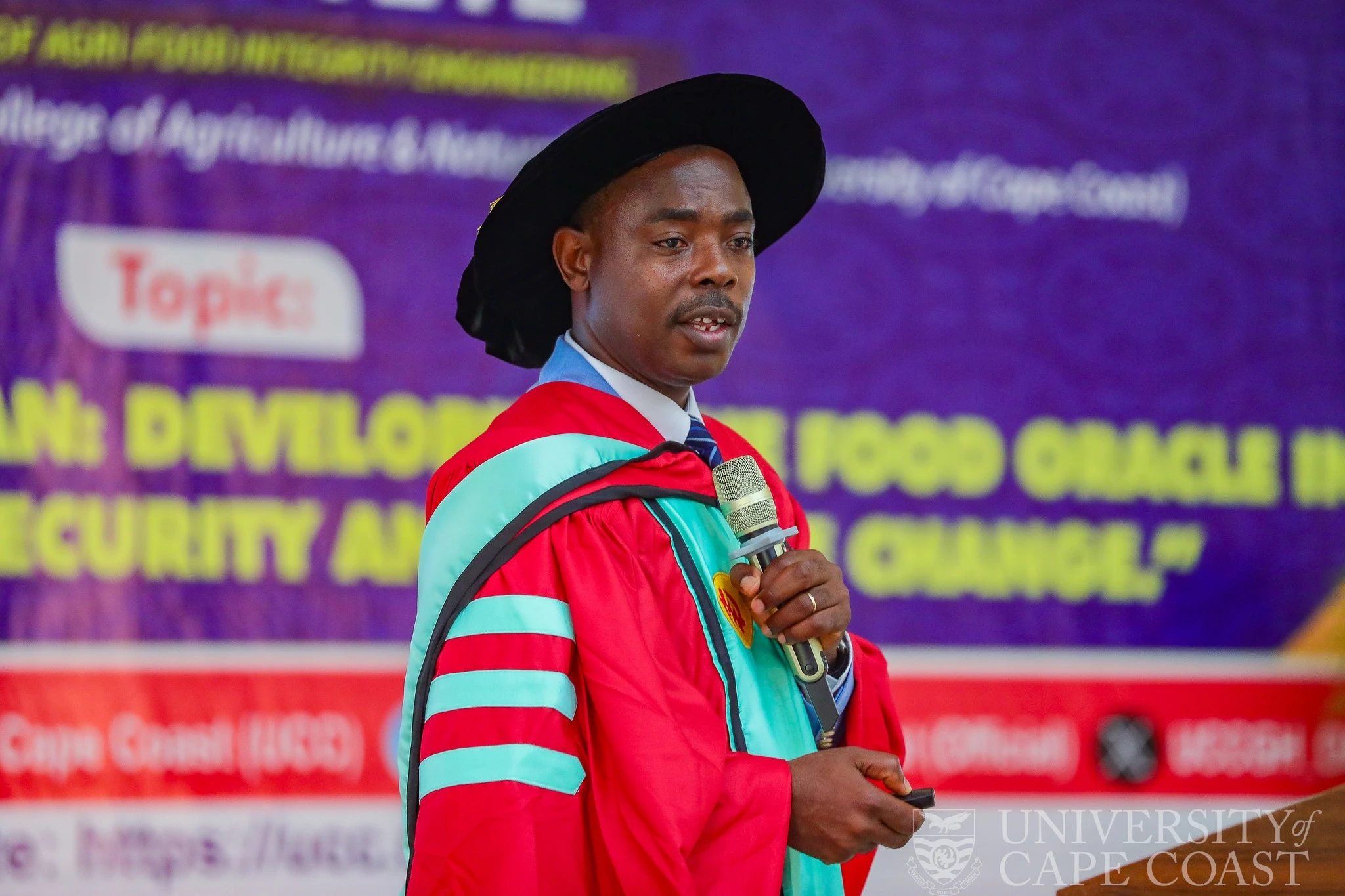
Prof. Teye made these remarks when he delivered his inaugural lecture on the topic: “Angry Food-Hungry Man: Developing the Food Oracle in the Face of Food Insecurity and Climate Change.”
To fight food fraud, he indicated that he had developed a portable spectroscopy and smartphone-enabled technology to detect or verify food to ensure its preservation and integrity.
He expressed concern about the present situation where the market was flooded with fertilizers of unknown origin and quality.
Prof. Teye said fertilizers should be sold based on guaranteed nutrient composition, determined by various proven analytical methods.
“Importantly, “the Food Oracle” is not merely a technological innovation; it is a climate resilience strategy. Thus, precision soil diagnostics reduce wasteful fertilizer use and environmental degradation.
He indicated that seeds for crop cultivation and fertilizers should be regulated by a competent statutory body so that the integrity of food was not compromised.
“If we really want to save our health, we need to look at the food oracle. The soil should be healthy. We should be mindful of the input of fertilizer and seeds; we should not give them to anybody. If I have my own way, I will institute a law that fertilizer should not be in the hands of anybody but in the hands of an institution. Because any seed you put in the soil holds the future and health of someone,” he stressed.
For food authenticity, he said people should be conscious of proper food hygiene at the markets where foodstuffs and items were bought for the preparation of meals.
He recommended the establishment of a Food Authenticity Standard Club for UCC to ensure safe and nutritious food for all. Through this, authorities of the University would be abreast of where sellers buy their inputs. This, he said, would enable UCC to increase its monitoring activities to prevent students and staff from purchasing unwholesome products.
He expressed worry about the lack of market for locally grown rice and urged Ghanaians to change their mindset and patronize it, since it is more nutritious and healthier than imported rice.
He said the influx of foreign rice into the Ghanaian market and its associated patronage by Ghanaians continue to threaten the survival of the local rice industry.
“Local rice is the best. If you buy cheap food, you will buy expensive medicine,” he cautioned.
The inaugural lecture was chaired by the Acting Vice-Chancellor, Prof Denis Worlanyo Aheto.
Source: Documentation and Information Section-UCC