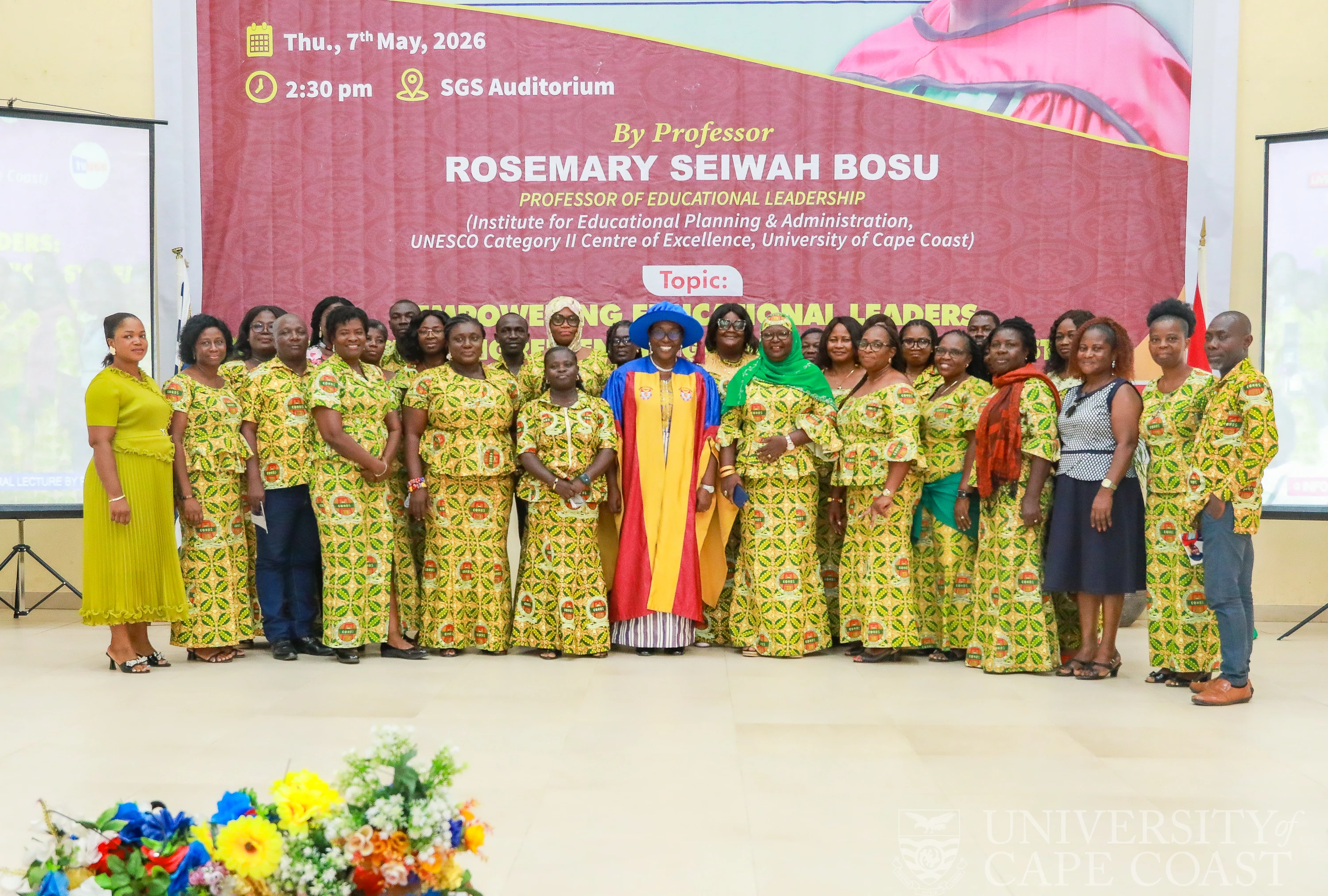
A Professor of Educational Leadership at the University of Cape Coast, Rosemary Seiwah Bosu, says the country’s educational reforms will not record any significant progress unless school leadership is strengthened and empowered.
Prof. Bosu made this call during her inaugural lecture on the theme “Empowering Educational Leaders: The Missing Ingredient in Ghana’s Educational System,”
Prof. Bosu observed that although Ghana has introduced several educational reforms since independence, limited attention has been given to preparing and empowering school leaders to effectively drive those reforms.
According to her, the country’s educational system continued to struggle with weak learning outcomes because leadership development has not received the needed national attention.
“Great schools are built by educational leaders and not by the builders,” she stressed.
The lecture, delivered at the School of Graduate Studies Auditorium, UCC, brought together academics, educational administrators, students and policy actors.
Drawing on her previous projects and other literature, Prof. Bosu explained the significant differences between high-performing schools and those with poor learning outcomes, was largely based on the quality of leadership.
She noted that school leaders in poorly performing schools often focused mainly on administrative duties, while leaders in successful schools inspired teachers, communicated effectively with communities and prioritised teaching and learning.
She said educational leadership remained second only to teachers in influencing students’ academic performance, adding that effective leadership was central to achieving Sustainable Development Goal Four (SDG 4), which seeks equitable and quality education for all by 2030.
Despite Ghana’s numerous reforms, including the 1987 Education Reform, the Free SHS Policy and the Standard-Based Curriculum, Prof. Bosu said educational quality remained a challenge.
Citing findings from the 2025 WASSCE results, she indicated that performance in core subjects such as Mathematics has declined significantly, despite increased school enrolment across the country.
“At the primary level, many pupils are still unable to attain basic literacy and numeracy levels, while at the secondary level, more students are enrolling but fewer are passing,” she stated.
Prof. Bosu identified fragmented policy frameworks, weak leadership preparation, lack of professional standards and limited autonomy as major obstacles affecting school leadership in Ghana.
She explained that overlapping responsibilities among agencies such as the Ministry of Education, Ghana Education Service and the National Teaching Council often created confusion and weakened accountability within schools.
She further observed that appointments of school heads largely focused on teaching experience rather than leadership competencies such as strategic planning, communication, conflict management and data driven decision making.
“Without these skills, many school leaders rely on trial and error and learning on the job,” she noted.
The professor also lamented the absence of structured professional training for school leaders before appointment, saying most heads depended on personal initiative and informal learning to manage schools.
To address the situation, she proposed a five pillar framework centred on professional leadership standards, structured leadership training, autonomy with accountability, data and technology use, and community based leadership.
She urged policymakers to intentionally invest in school leaders through sustained professional development, supportive policies and stronger leadership structures.
“When educational leaders are equipped with authority, skills and community support, they can build strong learning communities capable of transforming Ghana’s education system,” she said.