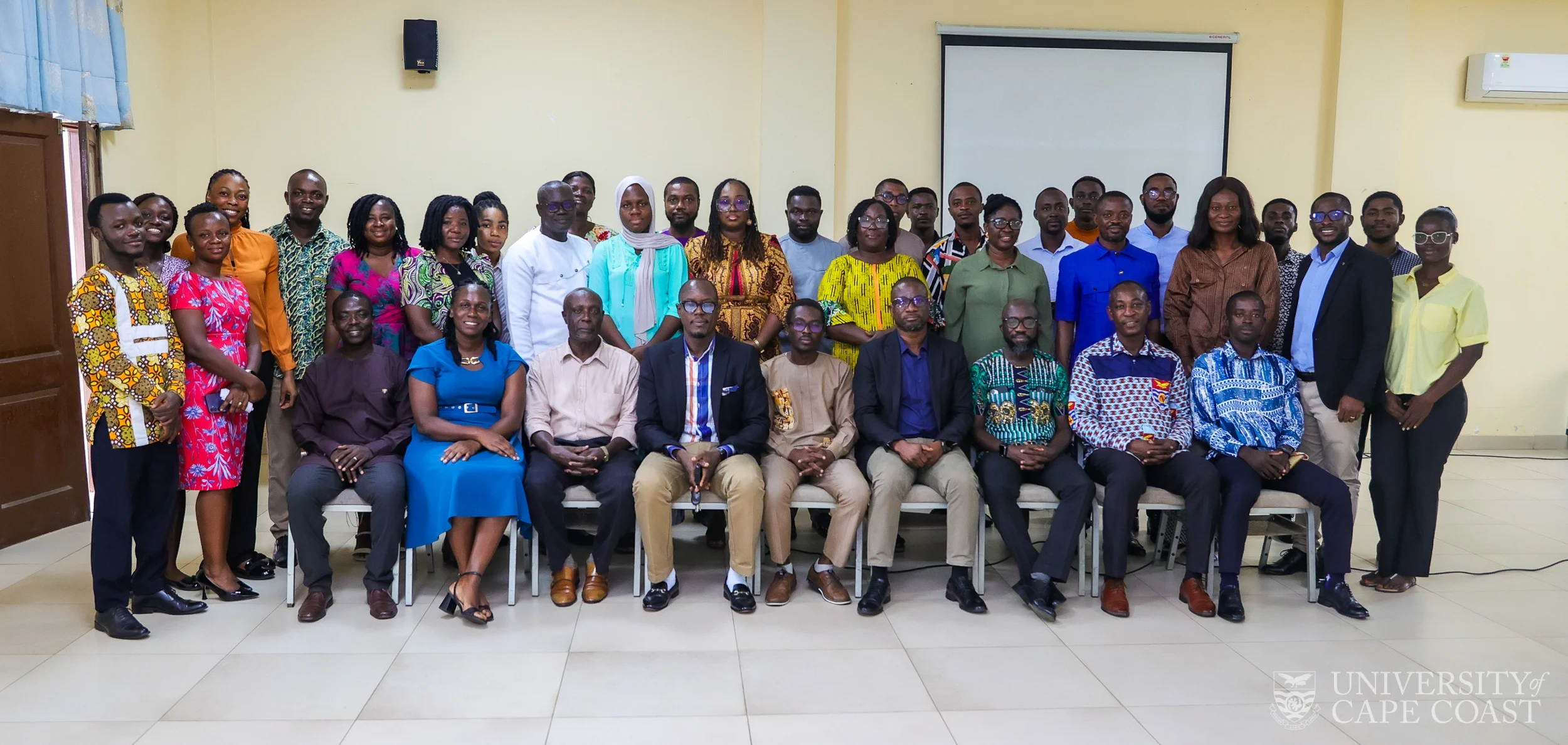
A Research Summer School training programme designed to build the capacity of researchers in research-related issues and tools has been held at the University of Cape Coast (UCC).
Spearheaded by the Directorate of Research Innovation and Consultancy (DRIC) of UCC, the three-day training is aimed at meeting individual researchers' different needs and experiences for their professional advancement.
The participants, drawn from public and private organisations in the country, were taken through areas such as research visibility, intellectual property issues in research, research ethics, stress and time management, research communication and dissemination, and grant-making.
Others were Qualitative and Quantitative Research Data Analyses and Management; Planning and Project Management; and Research, Ethics and Stewardship.
The Head of Department of Behavioural and Psychosocial Sciences of the School of Public Health, Prof. Samuel Asiedu Owusu, noted that the research summer school had been instituted by the University to build the capacity of researchers across the country in research-related issues and tools.
He noted that the goal of the Research Summer School was to advance the knowledge and skills of participants in specific aspects of research and grantmaking, provide opportunities for networking, and improve researcher visibility. identify their expectations for the training. He took participants through research ethics, explaining the importance of ethical principles in protecting the rights and welfare of research participants.
Professor Owusu pointed out four major principles of research ethics: autonomy, non-maleficence, beneficence and justice. He explained that autonomy required researchers to respect participants’ right to make informed and voluntary decisions, while non-maleficence requires researchers to avoid causing harm.
A Deputy Director of DRIC, Prof. Elvis Ofori Ameyaw, took participants through the module on “Author and Authorship,” highlighting the principles and responsibilities associated with academic publishing. He stressed that authorship should reflect meaningful intellectual contributions to research rather than seniority, position or institutional affiliation.
Prof. Ameyaw also discussed authorship challenges, including honorary or gift authorship, ghost authorship, attribution of contributions and disputes over authorship order. He encouraged researchers to establish clear authorship expectations at the beginning of research projects and emphasised the responsibility of authors to ensure accurate reporting, proper acknowledgement of sources and adherence to academic integrity.
Another Deputy Director of DRIC, Prof Michael O. Adu, who made a presentation on “Researcher Visibility,” encouraged participants to make their research outputs discoverable, accessible and properly attributed. He highlighted the importance of visibility to research funding, promotion and tenure, collaboration and professional development.
He introduced participants to the four building blocks of the networked scholar—presence, sharing, connections and reputation—and highlighted platforms including Google Scholar, ORCID, Scopus and Web of Science.
The programme was delivered through three modules: Qualitative Research Methods; Quantitative Research Methods and Data Analysis; and Grant Proposal Writing, using a blended approach combining face-to-face and online sessions.
Participants received certificates at the end of the programme, with organisers expressing optimism about increased participation in future editions.