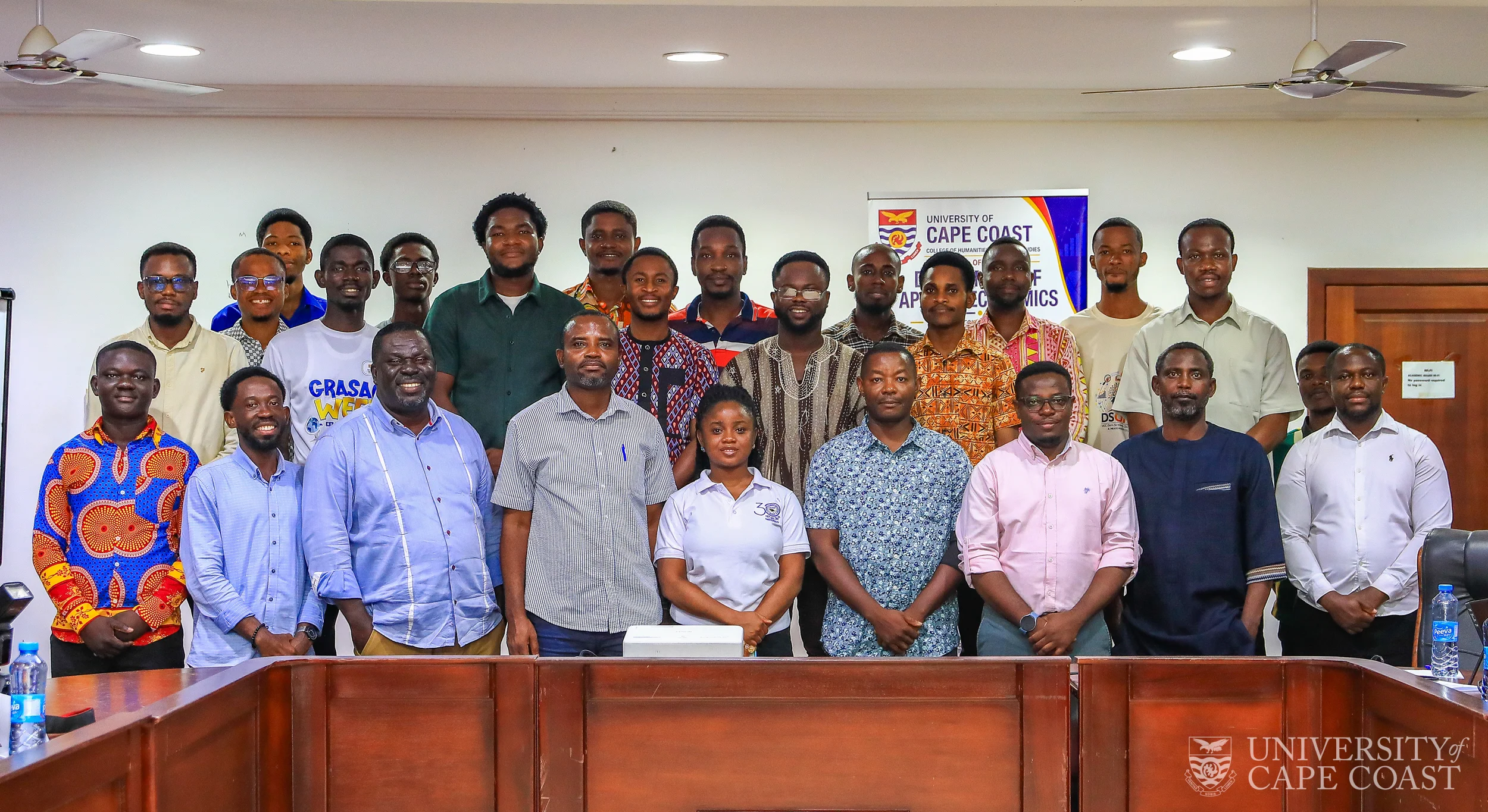
The Department of Applied Economics of the University of Cape Coast (UCC), in collaboration with the Social and Economic Policy Unit of the UNICEF Office of Research and Foresight–Innocenti, Italy, has organised a four-day Impact Evaluation Workshop.
The workshop aimed at strengthening evidence-based policymaking, promote efficient public spending, and ensure that public policies and development interventions are assessed against measurable outcomes.
It brought together faculty members, undergraduate and postgraduate students of the Department of Applied Economics to discuss the impact evaluation and its application in assessing the effectiveness of public policies and development programmes.
Delivering the keynote address, the immediate past Head of the Department of Applied Economics, Prof. Jacob Nunoo, underscored the importance of impact evaluation skills in today’s data-driven environment. He said the workshop was designed to equip participants with practical competencies to identify knowledge gaps, assess the costs of action and inaction, and evaluate the effectiveness of government policies and programmes.
Prof. Nunoo said the periodic workshop would strengthen the capacity of faculty members and students through hands-on training in policy evaluation techniques. He added that the initiative would deepen the Department’s collaboration with international organisations such as UNICEF and UNESCO, while promoting cross-border research, knowledge exchange and collaborative development initiatives.
Speaking during the first technical session, Dr. Kaku Attah Damoah of the UNICEF Office of Research and Foresight–Innocenti introduced participants to the fundamentals of impact evaluation. He emphasised the importance of distinguishing facts from assumptions when assessing policy interventions and challenged participants to examine whether major social programmes, including the Free Senior High School (Free SHS) policy, free sanitary pad distribution initiatives and National Health Insurance Scheme (NHIS) premium exemptions, had achieved their intended outcomes.
Dr. Damoah observed that despite substantial investments in public programmes, evidence on their effectiveness and value for money remained limited. He explained that impact evaluation provided evidence to improve programme effectiveness, strengthen accountability and guide efficient public expenditure. He also distinguished between retrospective evaluations, which assess programmes already implemented, and prospective evaluations, which are designed before an intervention begins to measure its effects over time.
Another technical session was led by Dr. Frank Otchere, also of UNICEF Innocenti, who focused on causal attribution and the assumptions required to generate credible impact evaluation findings. He explained that establishing causality requires an intervention to precede the observed outcome and that other plausible explanations must be adequately controlled.
Dr. Otchere introduced participants to the Stable Unit Treatment Value Assumption (SUTVA) and the UTOSTI framework—Unit, Treatment, Outcome, Setting and Time—as key elements in estimating treatment effects. He also highlighted threats to internal validity, including self-selection, maturation, regression to the mean, confounding, testing effects, the Hawthorne effect and non-representative samples.
Participants engaged in discussions and practical exercises using Ghanaian policy examples, applying impact evaluation concepts to real-world public policies and development interventions.