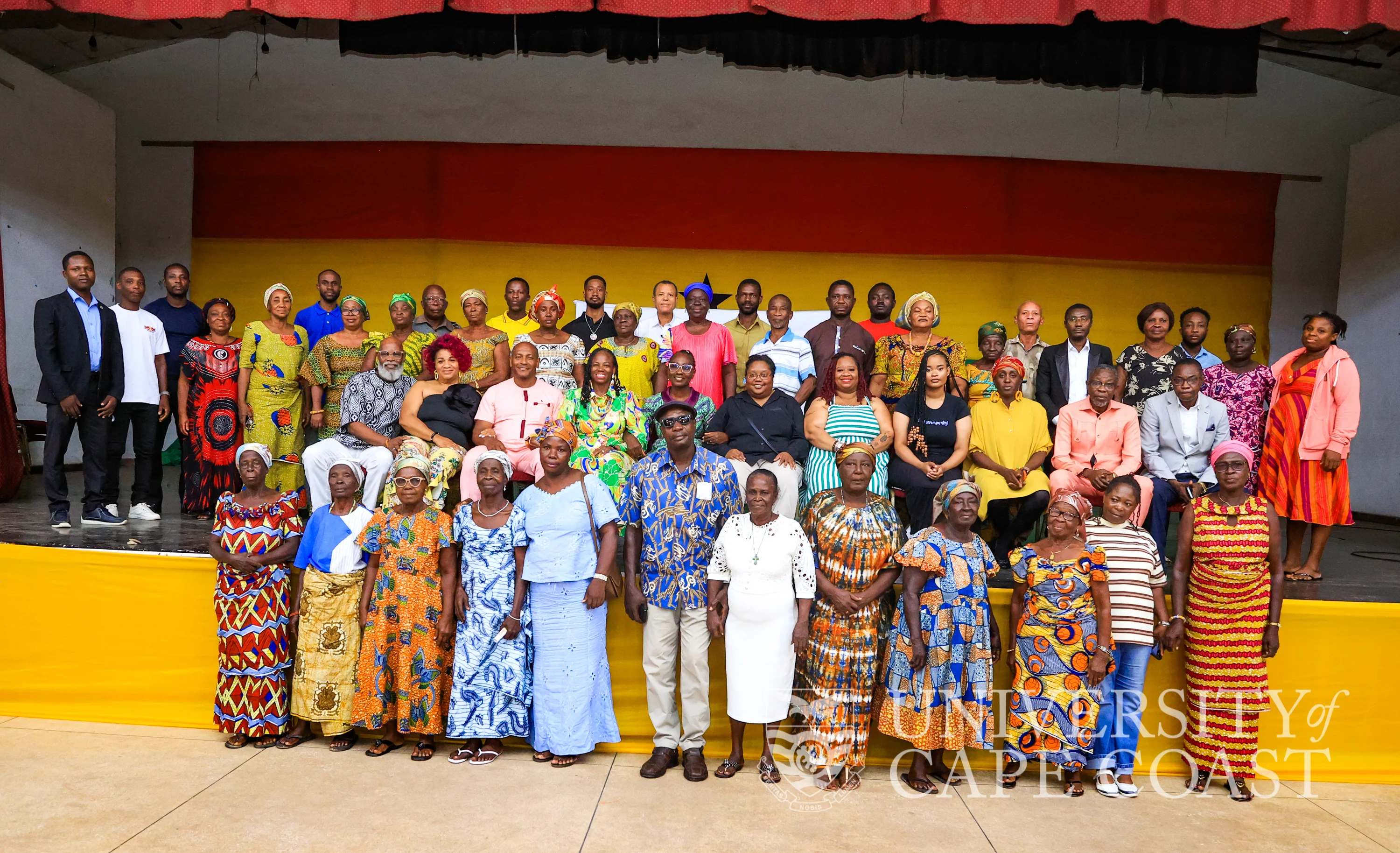
The maiden edition of the African Kinship Family Reunion Durbar has highlighted renewed calls for reparations for the transatlantic slave trade while reinforcing academic collaboration between the University of Cape Coast (UCC) and the University of Illinois at Urbana-Champaign (UIUC).
The event, held in Cape Coast on the theme, "Tracing the Echoes of History: Unravelling Ghana's Diaspora Post-Slave Trade," was jointly organised by the Department of Biomedical Sciences at UCC and the Department of Anthropology at UIUC. It formed part of efforts to reconnect people of African descent with their ancestral heritage through historical research and DNA-based family tracing.
Delivering the keynote address, an Assistant Professor in the Department of Anthropology at UIUC, Prof. Kakisha T. David, defended the growing campaign for reparations for Africa and people of African descent affected by the transatlantic slave trade.
She stressed that the demand for reparations was not a request for charity but a legitimate call for justice.
"The call for reparations is not a plea for alms but a valid demand for justice. If reparations can rightly be paid to victims and descendants of victims of the Holocaust, then reparations can also be paid to the descendants of victims of the slave trade. It has been four hundred years, and we want to bring closure to this tragedy," she stated.
Prof. David explained that the transatlantic slave trade began with the forced transportation of Africans to the Americas in 1619 and expanded into more than 36,000 voyages that saw millions of Africans taken from West and Central Africa into slavery across the Americas and the Caribbean.
According to her, the long-term social, economic and cultural consequences of the slave trade continue to affect African nations and their descendants across the globe.
She also called on countries that participated in the transatlantic slave trade to issue a formal apology to Africa for what she described as a crime against humanity.
In a solidarity message, Prof. Carol Ammons, a Democratic member of the Illinois House of Representatives representing the 103rd District, argued that apologies alone were insufficient to address the enduring effects of slavery and colonialism.
She noted that countries involved in the slave trade and colonial exploitation have a moral responsibility to provide meaningful reparations to affected nations.
Prof. Ammons maintained that reparations go beyond financial compensation and represent an acknowledgment of historical injustices and a commitment to correcting them.
"Reparations are more than merely financial transactions; they are a moral and ethical obligation. They represent our acknowledgment of past wrongs and, more importantly, the resolve to make amends," she said.
She further observed that many African countries continue to grapple with poverty and underdevelopment linked to the enduring legacy of slavery, oppression and colonialism.
For her part, a Senior Lecturer in the Department of Biomedical Sciences at UCC, Dr. Richael O. Mills, expressed appreciation to the University of Illinois at Urbana-Champaign for partnering with the Department to organise the programme.
She also thanked the people of Cape Coast who voluntarily provided DNA samples to support the African Kinship Reunion initiative, explaining that their participation would contribute significantly to efforts aimed at reconnecting members of the African diaspora with their ancestral roots.
Dr. Mills expressed optimism that the collaboration between UCC and UIUC would deepen research into African ancestry, heritage and identity while fostering stronger academic partnerships and cultural exchange between Ghana and the African diaspora.