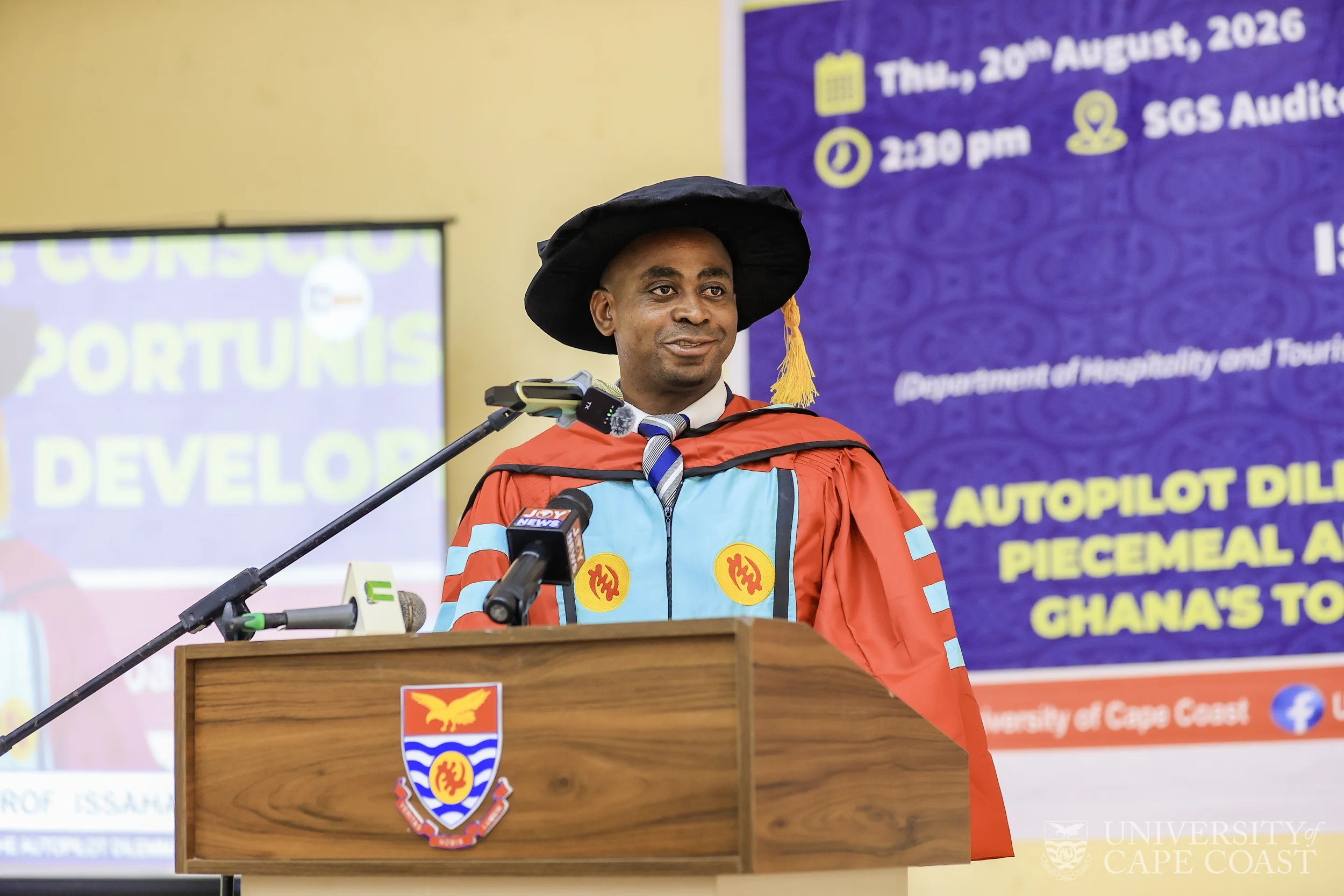
A Professor of Tourism Management at the University of Cape Coast (UCC), Prof. Issahaku Adam has called for a deliberate, coordinated and business-oriented approach to tourism development to enable Ghana to maximise the sector’s economic, social, cultural and environmental benefits.
He made the call during his inaugural lecture on the title “The Autopilot Dilemma: Conscious and Coordinated or Piecemeal and Opportunistic Approach in Ghana’s Tourism Development Journey,” delivered at the School of Graduate Studies Auditorium of UCC.
Prof. Adam argued that Ghana’s tourism development trajectory had largely been characterised by fragmented and piecemeal initiatives, despite the sector’s considerable potential to contribute to national development.
He maintained that a more conscious and coordinated approach was required to transform tourism into a stronger driver of sustainable economic development.
According to him, tourism remained a significant contributor to the global economy, accounting for about 9.9 per cent of global Gross Domestic Product (GDP) and supporting approximately 376 million direct, indirect and induced jobs. He noted that tourism also contributed to foreign exchange earnings, entrepreneurship and employment opportunities while creating avenues for socio-cultural development and sustainability.
In Ghana, he observed that the sector had grown steadily over the past two decades, contributing about US$4.34 billion to the economy in 2025 and accounting for approximately five per cent of GDP.
Therefore, Prof. Issahaku called for increased government investment in Ghana’s tourism sector, arguing that greater state commitment was essential to unlocking the sector’s full potential and positioning tourism as a major driver of economic growth and development.
He cited Senegal as an example of a West African country that has demonstrated stronger financial commitment to tourism, noting that the country invests about twice Ghana’s budgetary allocation to the sector. According to him, increased investment in tourism infrastructure, promotion and development could significantly enhance Ghana’s competitiveness as a preferred destination.
Prof. Adam, however, expressed concern that Ghana’s rich tourism resources remain largely underdeveloped despite the country’s natural, cultural and heritage attractions, including its tropical climate and long sandy coastline.
He contended that the limited impact of tourism on Ghana’s socio-economic development was partly attributable to inadequate coordination, weak product development, insufficient infrastructure and a lack of a holistic approach to tourism marketing, branding and destination positioning.
“Tourism development in Ghana has yielded some noticeable gains, particularly in the context of socio-economic benefits; it remains largely uncoordinated and piecemeal and thereby limiting its growth as well as ability to drive the needed socio-economic, cultural and environmental development,” he stated in the lecture.
Prof. Adam called for increased government commitment and investment in tourism infrastructure as a foundation for long-term economic transformation at the local and national levels. He urged government to treat tourism development as both an economic and social investment rather than as a passive or business-as-usual activity.
He observed that sustained government interest and strategic initiatives had the potential to transform the tourism sector by attracting more international visitors, creating employment opportunities and generating increased revenue for the country. He stressed the need for government to continue investing in initiatives that promote Ghana’s cultural heritage, attractions and tourism offerings.
He cited the Year of Return, Beyond the Return and December in Ghana as examples of successful government-led initiatives implemented through the Ministry of Tourism. He said such initiatives had demonstrated the impact of deliberate state interventions in raising Ghana’s profile globally and attracting visitors, adding that similar sustained efforts could further accelerate the growth and development of the tourism industry.
He further recommended that the Ghana Tourism Authority (GTA) should be repositioned to work more closely with the Ghana Tourism Development Company (GTDC) and other relevant institutions to strengthen coordinated product development, destination marketing and infrastructure development.
Prof. Adam also advocated greater autonomy and participation of Metropolitan, Municipal and District Assemblies (MMDAs) in tourism development, arguing that decentralisation would enable local authorities to invest more effectively in tourism infrastructure and products while creating jobs, generating revenue and promoting socio-economic development within their communities.
He stressed the need to enhance and diversify Ghana’s tourism product base and strengthen linkages between tourism products and destinations. This, he noted, would help create a more competitive tourism sector capable of delivering sustained benefits to communities and the national economy.
The inaugural lecture was chaired by the Vice-Chancellor of UCC, Prof. Denis Worlanyo Aheto.
Prof. Adam is a Professor of Tourism Management in the Department of Hospitality and Tourism Management and Vice-Dean of the Faculty of Social Sciences at UCC.