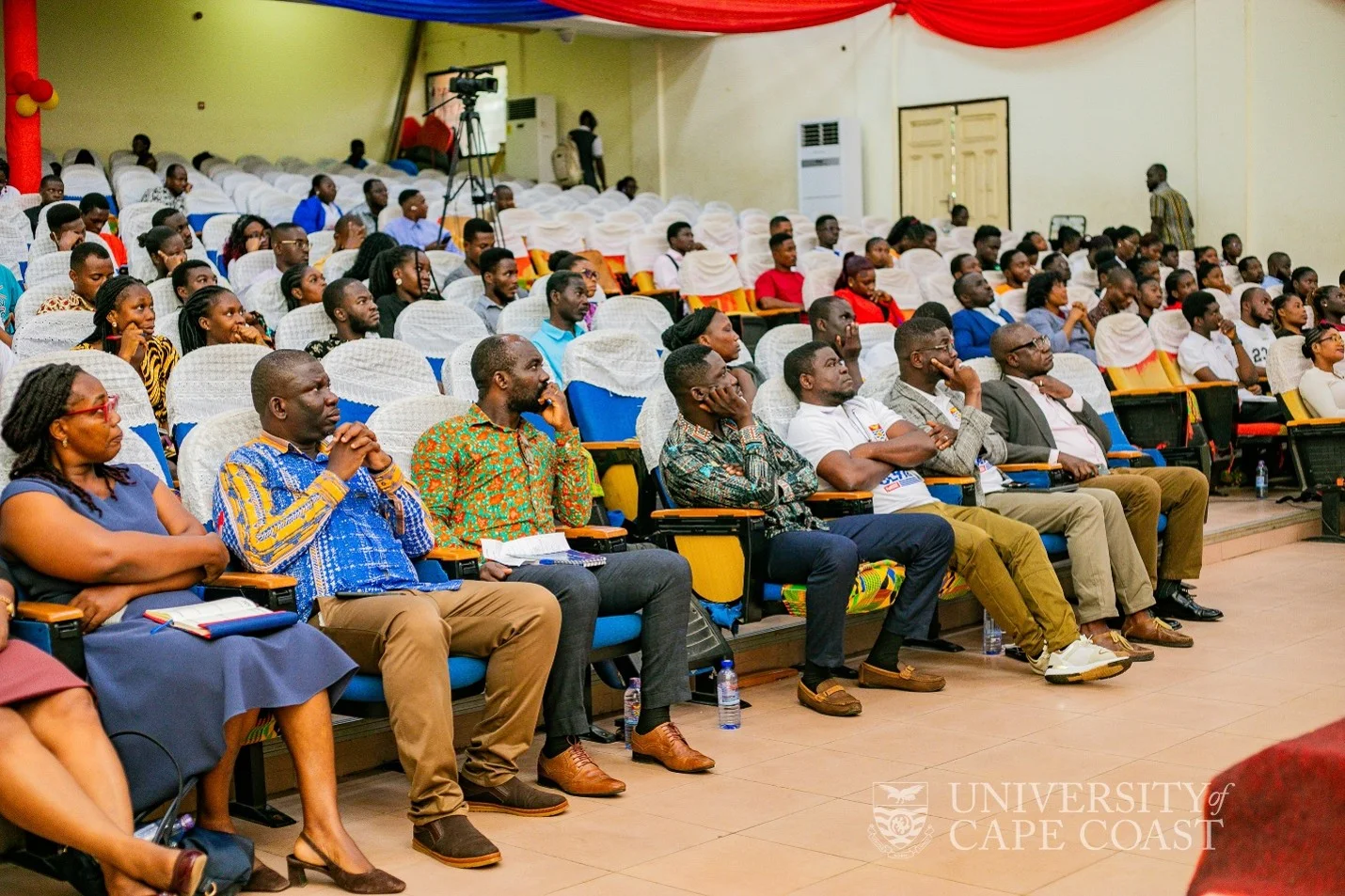
The Faculty of Humanities and Social Sciences Education (FoHSSE) has organised a day’s public lecture on the theme: “Language Use in Ghanaian Classrooms: Ideals and Realities.”
The lecture was delivered by a former Dean of the Faculty of Languages, University of Education, Winneba, Prof. Yaw Sekyi-Baidoo.
In his opening remarks, Professor Eric Mensah, Dean of FoHSSE, noted that the ongoing national debate surrounding the Ministry of Education’s directive to the Ghana Education Service (GES), requiring basic school teachers nationwide to immediately begin using Ghanaian languages as the medium of instruction for pupils in kindergarten through to class three, prompted the Faculty to wade into the discussion.
He said the theme addressed a subject crucial to teaching, learning, and national development.
Prof. Mensah stated that Language was not merely a medium of communication but a vehicle of knowledge transmission, cultural identity, critical thinking, and social interaction.
“The language choices made in our classrooms significantly go a long way to influence learners' academic achievement, participation, engagement, confidence, and the overall educational experience,” he indicated.
In Ghana, according to him, language and education policies had long sought to balance the promotion of indigenous languages with the practical realities of a multilingual society and the role of English as an official language.
“While policy ideals advocate the use of learners' mother tongue, particularly in the early years of school, classroom realities often present a more complex picture.
The public lecture, therefore, according to Prof. Mensah, provided a timely platform for critical reflection and scholarly dialogue on these issues.
“It offers us an opportunity to examine the gap, if there is any, between policy aspirations and classroom practices and to explore evidence-based strategies that can enhance teaching and learning outcomes in our classrooms,” he added.
Delivering the lecture, Prof. Yaw Sekyi-Baidoo lauded the ministry’s directive, indicating that such a move would protect and keep the local language from sinking.
He explained that “A language for education policy is not a simple policy declaration. It is a national cultural resolve, mindset, and agenda for self-preservation and identity.”
He said that the policy would give students who did not have access to the school context due to language difficulties an opportunity to learn and build their language proficiency in English.
Prof. Sekyi-Baidoo stressed the fact that language was a critical tool for learning and that schoolchildren who were not proficient in the language of instruction might struggle to access the curriculum.
He called on all stakeholders to ensure strict enforcement of the directive to improve teaching and learning outcomes at the foundational level.
He called for the need to use local languages for cultural identity and perspective to be established in our lives, in our minds.
To this end, he said chiefs should be put at the center of local languages promotion instead of politicians, who could bring disintegration among the citizens.
"Let this remain in the minds of the people, and let traditional leaders take centre stage. Politicians can sometimes be divisive, but traditional leaders have the unique ability to unite their communities. When discussions are conducted in our regional languages, consensus can easily be reached among the chiefs. Once the chiefs are united in agreement, their communities are more likely to embrace and support those decisions," he explained.
The Dean of the School of Educational Development and Outreach (SEDO), Prof. (Mrs.) Christine Adu-Yeboah, who chaired the lecture, described it as timely. She noted that the Ministry’s directive was necessary to build a sound educational footing for pupils.
Source: Documentation and Information Section-UCC