A Professor of Fisheries and Aquatic Science, Joseph Aggrey-Fynn, has attributed Ghana’s declining fish stocks largely to illegal fishing practices and weak enforcement of existing regulations.
He warned that the country risked further depletion of its marine resources if urgent action was not taken.
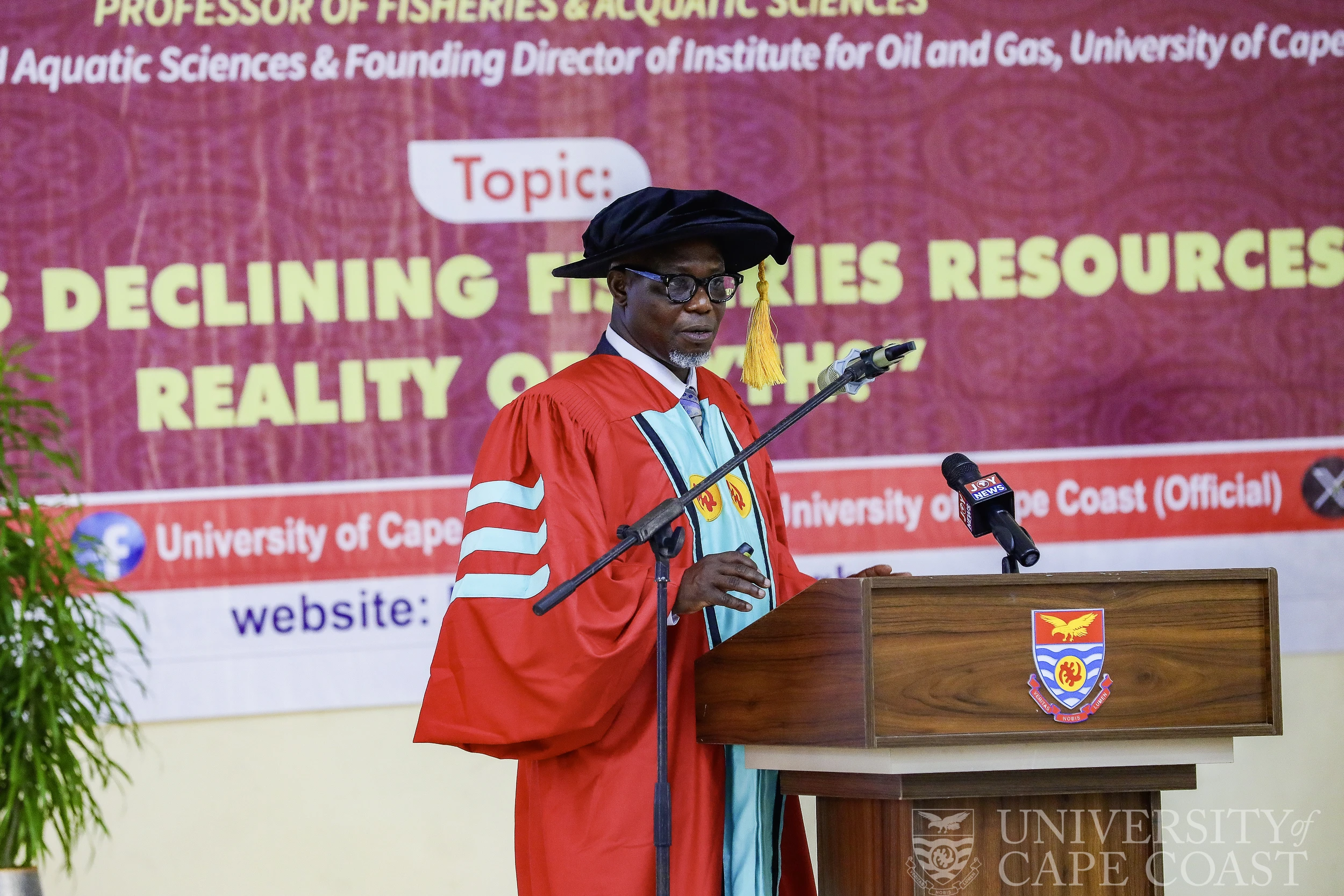
Delivering his inaugural lecture at the University of Cape Coast (UCC) on the theme, “Ghana’s Declining Fisheries Resources: Reality or Myth,” Prof. Aggrey-Fynn stated emphatically that the decline in fish stocks was real and supported by scientific evidence.
He identified Illegal, Unreported and Unregulated (IUU) fishing as a major contributor to the problem, noting that destructive methods such as the use of small mesh nets, explosives, and harmful chemicals continue to threaten marine life and human health.
“IUU fishing must stop or at least be reduced to the barest minimum,” he stressed, explaining that such practices not only destroy fish stocks but also undermine the livelihoods of fishers themselves.
According to him, although regulations exist, the inability to effectively monitor Ghana’s vast coastline has made enforcement difficult, allowing illegal activities to persist.
Prof. Aggrey-Fynn further highlighted that the country’s fisheries sector, which supported the livelihoods of nearly three million Ghanaians and contributed significantly to national nutrition, was under serious pressure.
He explained that fish accounts for about 60 per cent of the animal protein consumed in Ghana, with per capita consumption exceeding the global average, underscoring the importance of safeguarding the sector.
Tracing the historical trajectory of the industry, he noted that Ghana’s fisheries experienced significant growth between the 1950s and 1980s, a period he described as the “golden years,” driven by increased fishing effort and expansion of fleets.
However, he said the absence of strong conservation measures during that period, coupled with increasing fishing pressure, laid the foundation for the current decline.
The professor also pointed to climate change as an emerging factor, explaining that rising sea temperatures were forcing fish species to migrate to cooler waters, thereby reducing local catch. He cited the sharp decline in small pelagic species such as sardinella, considered the backbone of Ghana’s fisheries, as evidence of the ongoing depletion.
On policy interventions, Prof. Aggrey-Fynn acknowledged recent efforts, including the passage of the Fisheries and Aquaculture Act, 2025 (Act 1146), which introduced stricter penalties and improved regulatory frameworks. He, however, emphasised that laws alone were not sufficient without strict enforcement and stakeholder cooperation.
“We have good laws, but enforcement remains the challenge,” he noted, calling for stronger collaboration between government, regulatory bodies and fishing communities.
Beyond regulation, he advocated the adoption of sustainable practices such as the establishment of marine protected areas, fish sanctuaries, and artificial reefs to help replenish fish stocks.
He also encouraged diversification within the sector, including the development of marine tourism activities such as whale and dolphin watching, to reduce pressure on fishing.
Additionally, he urged a shift in consumer preferences towards underutilised fish species to ease demand on heavily exploited stocks.
Prof. Aggrey-Fynn further stressed the need to provide alternative livelihoods for fishing communities, noting that economic pressures often push fishers into illegal practices.
He concluded that while the challenges facing Ghana’s fisheries sector were significant, they were not insurmountable if decisive and coordinated action was taken.
“The decline is real, but it can be reversed if we act responsibly and collectively,” he said.
Source: Documentation and Information Section - UCC