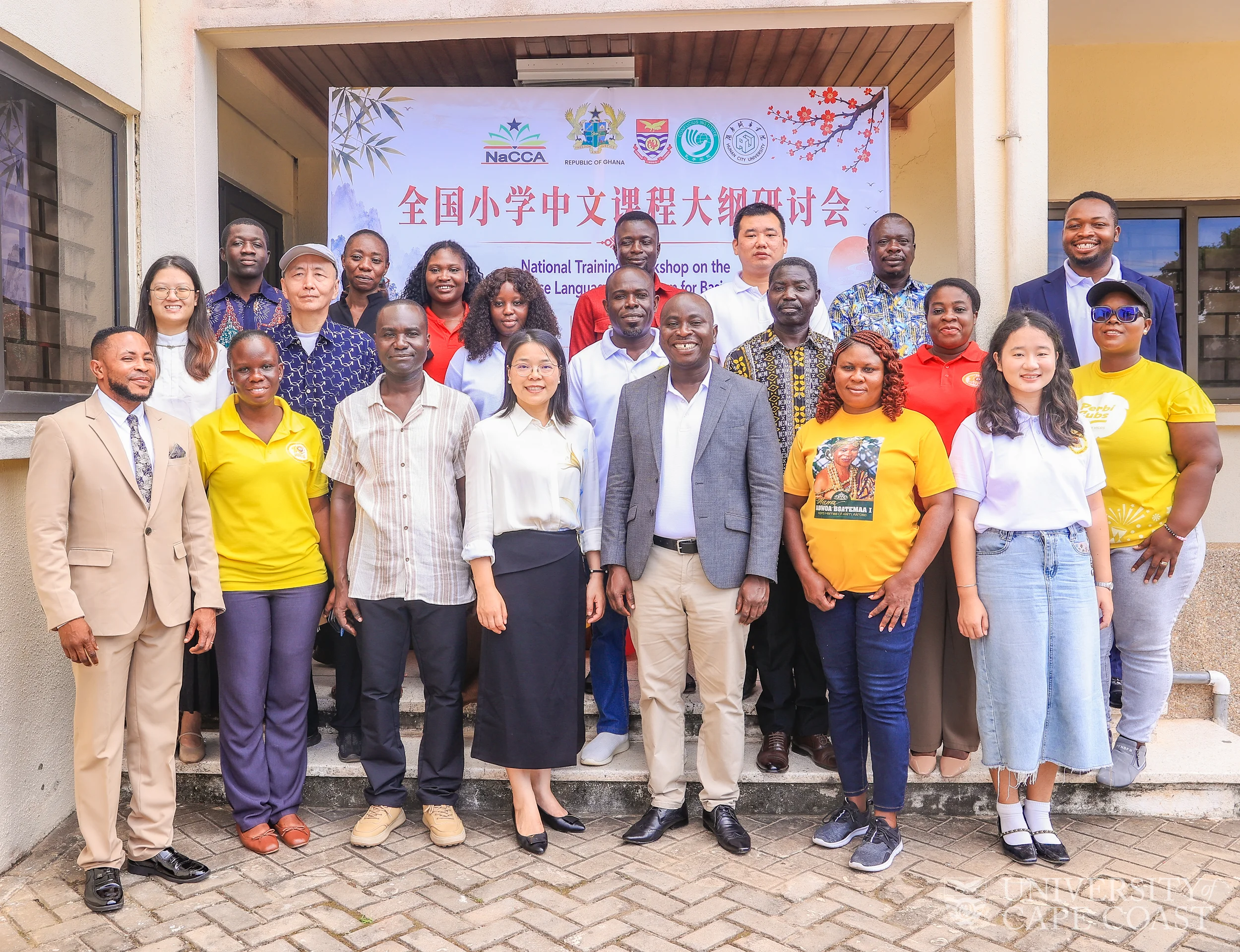
The National Council for Curriculum and Assessment (NaCCA) has held a national training workshop to equip basic school teachers with the knowledge and skills needed to implement the new Chinese language curriculum effectively.
The Confucius Institute at the University of Cape Coast (UCC) initiated the training, which was held at the Conference Room of the Institute of Education.
Speaking at the opening ceremony, the Deputy Director of NaCCA, Dr Eric Amoah, said the partnership between NaCCA and the Confucius Institute at UCC would strengthen curriculum development and create opportunities for language learning, cultural exchange and international collaboration.
He said the new Chinese language curriculum would prepare Ghanaian learners for an increasingly globalised world by equipping them with relevant language and cultural skills.
Dr Amoah noted that the training programme would equip teachers with the knowledge, skills and confidence needed to effectively deliver the curriculum.
“Let us move forward hand in hand to build a legacy of learning and partnership that will endure for generations,” he said.
He urged participants to actively engage in the training, share knowledge and embrace continuous improvement. He also encouraged teachers to serve as ambassadors of change and help develop inclusive and globally minded citizens.
The Provost of the College of Humanities and Legal Studies, Professor Daniel Agyapong, for his part, urged Chinese language instructors to teach students some Ghanaian local languages alongside Chinese.
He noted that while Ghanaian students were making strenuous efforts to learn the Chinese language and culture, Chinese instructors should also encourage cultural exchange by introducing students to Ghanaian languages and traditions.
Earlier, in her welcome address, the Chinese Director of the Confucius Institute at UCC, Prof Zhang Yonghong, emphasised the importance of the training in equipping teachers with the knowledge and skills needed to effectively teach Chinese to young learners.
She traced the institute’s journey from its beginnings in 2008 to its approval by Hanban in December 2015 and its official launch in June 2016.
She described the institute as a product of a sustained partnership among UCC, its Chinese partner university and the Chinese Embassy, noting that it had grown into a vibrant hub for language learning, cultural exchange, academic collaboration and community engagement.
In a brief remark, the Ghana Director of the Confucius Institute at UCC, Prof Emmanuel Amo Ofori, encouraged participants to apply the knowledge and skills gained from the sessions to support effective teaching and learning, particularly in the implementation of the new curriculum.
The training programme was organised into six sessions to familiarise participants with the new Chinese language curriculum and strengthen their capacity to implement it effectively.
The first session, led by the Head of Curriculum at NaCCA, Mr Reginald Quartey, focused on the Kindergarten and Primary Curriculum Review 2026. The session provided participants with an overview of the curriculum review and its relevance to basic education.
The second session, facilitated by Ms Anastasia Emefa Awudzah of NaCCA, examined the background, philosophy and structure of the new Chinese language curriculum, giving participants an understanding of the principles guiding its development.
Mr Charles Delali Adegah of NaCCA led the third session on curriculum content and the expected Chinese language proficiency of learners. The session highlighted the knowledge and language competencies learners are expected to acquire.
The fourth session, facilitated by Mr Yu Zhen of the Confucius Institute at UCC, focused on pedagogical exemplars and assessment rubrics, equipping participants with practical approaches to teaching and assessing Chinese language learners.
Participants were subsequently divided into three groups for the fifth session, during which they practised teaching and learning activities based on the new curriculum. The practical session allowed participants to apply the knowledge and teaching approaches acquired during the training.
The final session focused on the role of the Chinese language coordinator in strengthening school-parent-teacher partnerships for effective Chinese language education in Ghana. The session was led by Mr Robert Quayenor Odametey, who highlighted the importance of collaboration among schools, parents, and teachers in supporting effective Chinese language education.