The Director-General of the Institute for Educational Planning and Administration (IEPA), a UNESCO Category II Centre at the University of Cape Coast (UCC), Prof. Michael Boakye-Yiadom, has participated in the Global Future Higher Education Summit held at the Southern University of Science and Technology (SUSTech) Convention Center in Shenzhen, China.
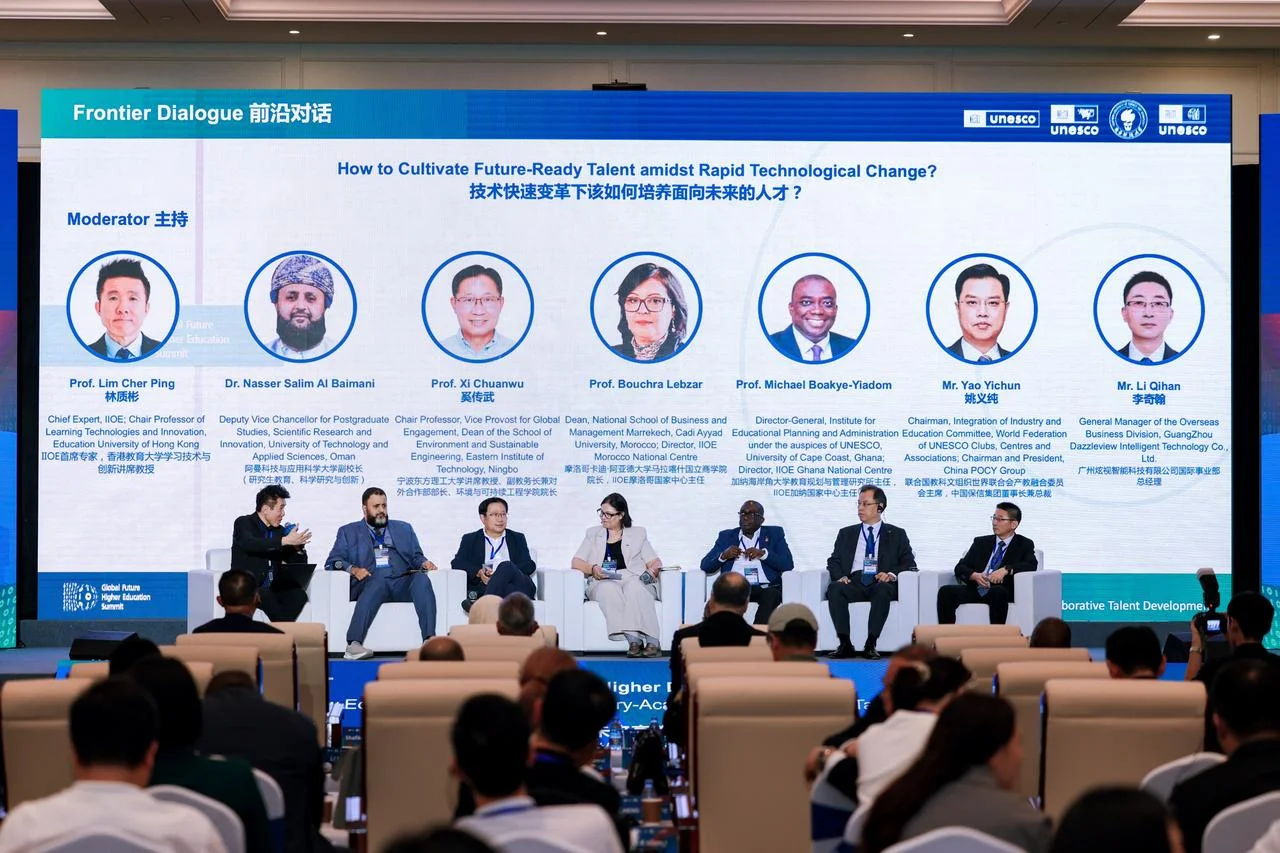
As a panel member, Prof. Boakye-Yiadom contributed to discussions on a New Ecosystem for AI-Driven Industry-Academia Collaborative Talent Development.
The summit was jointly hosted by the UNESCO International Centre for Higher Education Innovation (UNESCO-ICHEI), UNESCO Regional Office for East Asia (UNESCO Beijing), and the UNESCO Institute for Information Technologies in Education (UNESCO IITE).
During the dialogue, Prof. Boakye-Yiadom shared insights on strategies for developing future-ready talent and equipping learners with the skills needed to thrive amid rapid technological advancements and the growing influence of artificial intelligence.
Prof. Boakye-Yiadom emphasized that developing future-ready talent requires a holistic ecosystem that remains human-centred and places equal importance on both technical competencies and soft skills.
Representing the Acting Vice-Chancellor of the University of Cape Coast, Prof. Denis Aheto, he highlighted the University's role as the host institution of the International Institute for Online Education (IIOE) Ghana National Centre.
Prof. Boakye-Yiadom underscored the need to uphold ethics, social responsibility, and the humanities in education. He further noted that strengthening teacher capacity should be a fundamental priority, while deeper collaboration between educational institutions and industry in curriculum development is essential.
He also advocated for the localisation of talent development strategies to reflect the unique socio-economic and cultural contexts of individual countries.
The panel discussion was moderated by Prof. Lim Cher Ping, Chief Expert at the IIOE. Other distinguished panellists included Dr. Nasser Salim Al Baimani, Deputy Vice-Chancellor for Postgraduate Studies, Scientific Research and Innovation at the University of Technology and Applied Sciences, Oman; Prof. Xi Chuanwu, Chair Professor, Vice Provost for Global Engagement, and Dean of the School of Environment and Sustainable Engineering at the Eastern Institute of Technology, Ningbo, China; and Prof. Bouchra Lebzar, Dean of the National School of Business and Management Marrakech at Cadi Ayyad University, Morocco, and Director of the IIOE Morocco National Centre.
The rest were Mr. YAO Yichun, Chairman, Integration of Industry and Education Committee, World Federation of UNESCO Clubs, Centres and Associations; Chairman and President, China POCY Group; Mr. LI Qihan, General Manager of the Overseas Business Division, GuangZhou Dazzleview Intelligent Technology Co., Ltd.
Prof. Boakye-Yiadom further stressed that higher education institutions (HEIs), international organizations, and key actors within the AI ecosystem must take the lead in building consensus and promoting AI as a public good. According to him, such collaborative efforts are essential to bridging existing gaps in the AI era and ensuring equity, accessibility, and inclusion in education and talent development.
He also noted that the summit provided a valuable opportunity to engage with global peers, foster strategic partnerships, and align the mission of the Institute for Educational Planning and Administration (IEPA) with international best practices in artificial intelligence and educational innovation.
The summit attracted more than 200 participants from 32 countries and regions, including representatives and leaders from prominent international organizations such as UNESCO’s Future of Learning and Innovation Division, the UNESCO Institute for Information Technologies in Education (UNESCO IITE), the Southeast Asian Ministers of Education Organization (SEAMEO), the Association of Arab Universities, the Arab League Educational, Cultural and Scientific Organization (ALECSO), the ASEAN University Network (AUN), and the Inter-University Council for East Africa (IUCEA).
Source: Documentation and Information Section-UCC