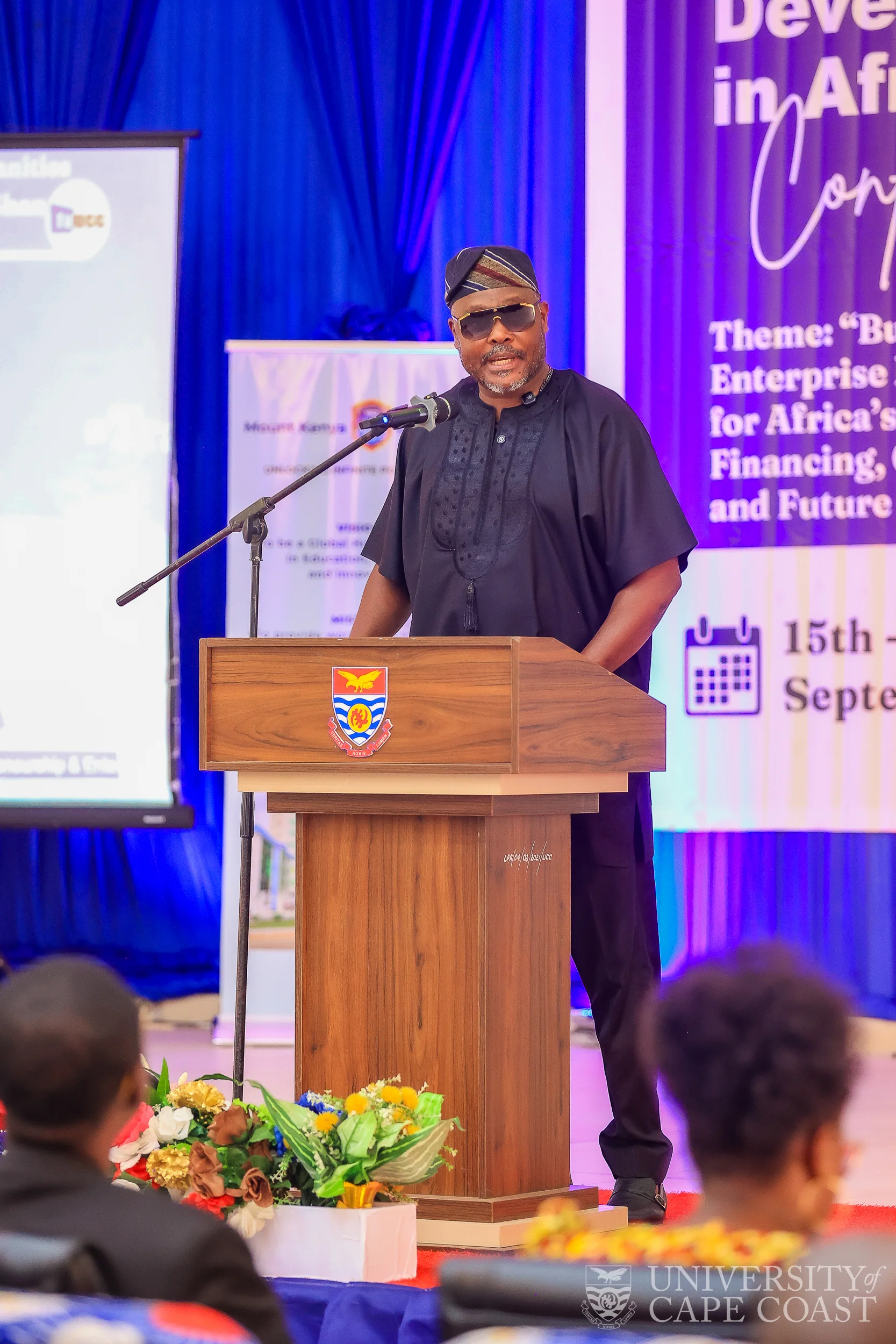
The Member of Parliament for Cape Coast North, Dr Kwamena Minta Nyarku, has called for stronger and more resilient enterprise ecosystems to help Africa harness its youthful population, technological capacity and entrepreneurial potential for sustainable economic transformation.
He said Africa was gradually entering into a new era shaped by digital transformation, artificial intelligence (AI), sustainability and changing patterns of work, making it necessary to create systems that support the development, financing and commercialisation of innovative ideas.
Dr. Nyarku made the call when he delivered the keynote address at the 14th Universities, Entrepreneurship and Enterprise Development (UEED) Africa Conference, organised in collaboration with Hochschule Bonn-Rhein-Sieg University of Applied Sciences, DAAD and the Ghana Circular Economy Centre, with funding from the European Union.
The conference was held on the theme, “Building Resilient Enterprise Development Ecosystems for Africa’s Digital and AI Future: Financing Secular Innovation and Future Jobs.”
“Africa has never lacked creativity or entrepreneurship,” Dr Minta Nyarko said, stressing that the major challenge was creating the support systems needed to transform promising ideas into sustainable and competitive enterprises.
He urged universities to move beyond their traditional roles of teaching and research and become stronger drivers of innovation and enterprise development. He encouraged students and researchers to identify societal challenges and explore ways of converting their knowledge and research into viable businesses.
“Research should not remain only within academic channels. It should reach communities and industries across the globe,” he said.
Dr Minta Nyarko also identified access to finance as a major constraint to enterprise development, calling for diverse financing mechanisms, including innovation grants, start-up funding and venture capital, particularly for high-growth businesses.
On artificial intelligence, he urged Africa to become an active developer of AI-based solutions rather than merely a consumer of technologies developed elsewhere. He cited opportunities in agriculture, healthcare, education and business.
“Technology alone will not transform Africa. People will transform Africa through technology,” he stated.
He further called for collaboration among governments, universities, industries, investors and entrepreneurs to build competitive and sustainable enterprises.
In his address, the Cape Coast Metropolitan Assembly Chief Executive, Mr. George Justice Arthur, urged entrepreneurs to pursue opportunities in the circular economy and collaborate with the Assembly to create jobs and stimulate investment.
“We invite you to help us turn waste into wealth in Cape Coast,” he said.
He also advised young people to consider entrepreneurship as a pathway to job creation, saying, “Do not just look for a job. Create one.”
Dr Marindame Kombate, Executive Director of the Ghana Circular Economy Centre, said Ghana needed stronger pathways for transforming ideas into commercially viable enterprises. “Ghana does not lack ideas,” he said, adding that the goal should be to move “from innovation to enterprise, and from enterprise to scale.”