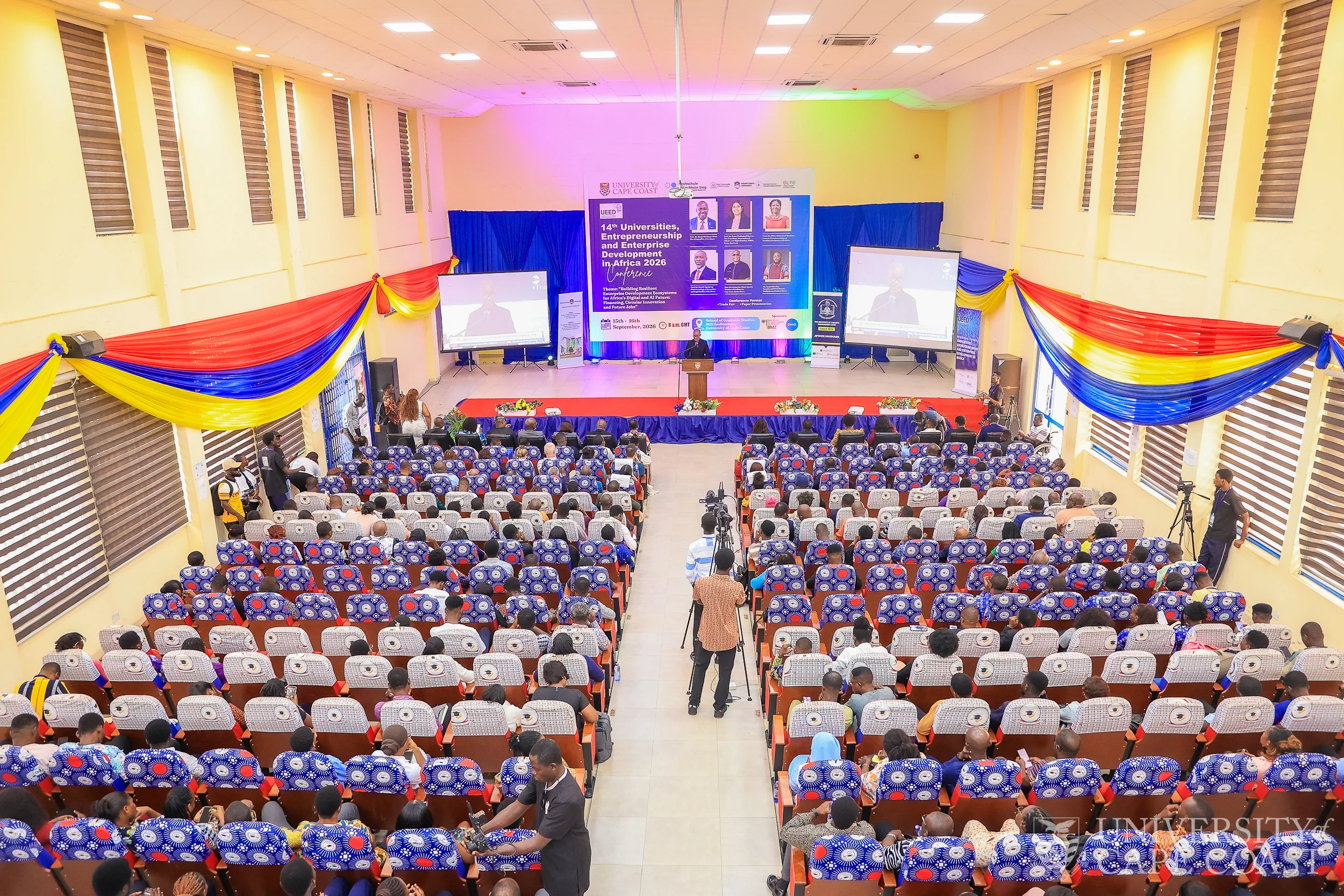
The 14th Universities, Entrepreneurship and Enterprise Development (UEED) Africa Conference has opened at the University of Cape Coast (UCC), bringing together academia, industry, business and development stakeholders to explore strategies for strengthening enterprise development and economic transformation in Africa.
The two-day conference, being held under the theme, “Building Resilient Enterprise Development Ecosystems for Africa’s Digital and Artificial Intelligence Future: Financing, Circular Innovation and Future Jobs, “is being attended by more than 400 participants in person and via Zoom.
The conference focuses on entrepreneurship and Small and Medium Enterprises (SMEs), market entry and development, international business between Germany and Africa, enterprise development, and the training and recruitment of qualified personnel. It is organised in collaboration with Hochschule Bonn-Rhein-Sieg University of Applied Sciences, the German Academic Exchange Service (DAAD), the Ghana Circular Economy Centre and with funding from the European Union.
Opening the conference, the Vice-Chancellor of UCC, Prof. Denis Worlanyo Aheto, called for a shift in the role of African universities from primarily preparing graduates to seek employment to equipping them to create enterprises and jobs.
“Are we simply preparing young people to search for jobs, or are we empowering them to create the enterprises and jobs that Africa needs?” he asked.
He identified Africa’s youthful population as a major development asset, but noted that unemployment, underemployment and insecure work continue to affect many young people entering the labour market.
Prof. Aheto stressed the need for universities to equip young people with digital skills, entrepreneurial competencies and access to opportunities and infrastructure to participate effectively in an increasingly technology-driven economy.
He also highlighted the importance of artificial intelligence, digital infrastructure, digital literacy, circular economy principles and green job creation in shaping Africa’s future. For coastal countries and institutions such as UCC, he said, the blue economy offers opportunities for research, innovation and enterprise development through the sustainable use of marine and coastal resources.
The Vice-Chancellor further announced UCC’s new AI-powered e-campus initiative as part of the University’s efforts to expand access to higher education and respond to changing workforce demands.
In a virtual address, the Vice-President of International Affairs and Digitalisation at Hochschule Bonn-Rhein-Sieg University of Applied Sciences, Prof. Dr. Teena Chakkabyll Hassan, said advances in AI were creating opportunities for innovation, economic growth and social empowerment.
She, however, emphasised the continuing importance of critical thinking, professional expertise, programming skills and disciplinary knowledge, noting that AI should complement rather than replace human judgement.
“AI tools should complement rather than replace human judgement and domain-specific knowledge,” she said.
The Provost of the College of Humanities and Legal Studies at UCC, Prof. Daniel Agyapong, called for the UEED Africa Conference to be expanded into a larger, more inclusive and globally recognised platform for enterprise development.
He said the conference had evolved into an important platform for connecting universities, businesses, policymakers and development partners and translating applied research, innovation, entrepreneurship and sustainable development into practical solutions.
Prof. Agyapong said the next phase of the conference should involve broader African ownership and stronger participation from universities, industry, investors and policymakers.
“We aim to broaden ownership of the conference and strengthen the African university network,” he said.
He expressed the hope that discussions and partnerships emerging from the 14th edition would translate into concrete opportunities and sustainable enterprises capable of contributing to Africa’s economic future.