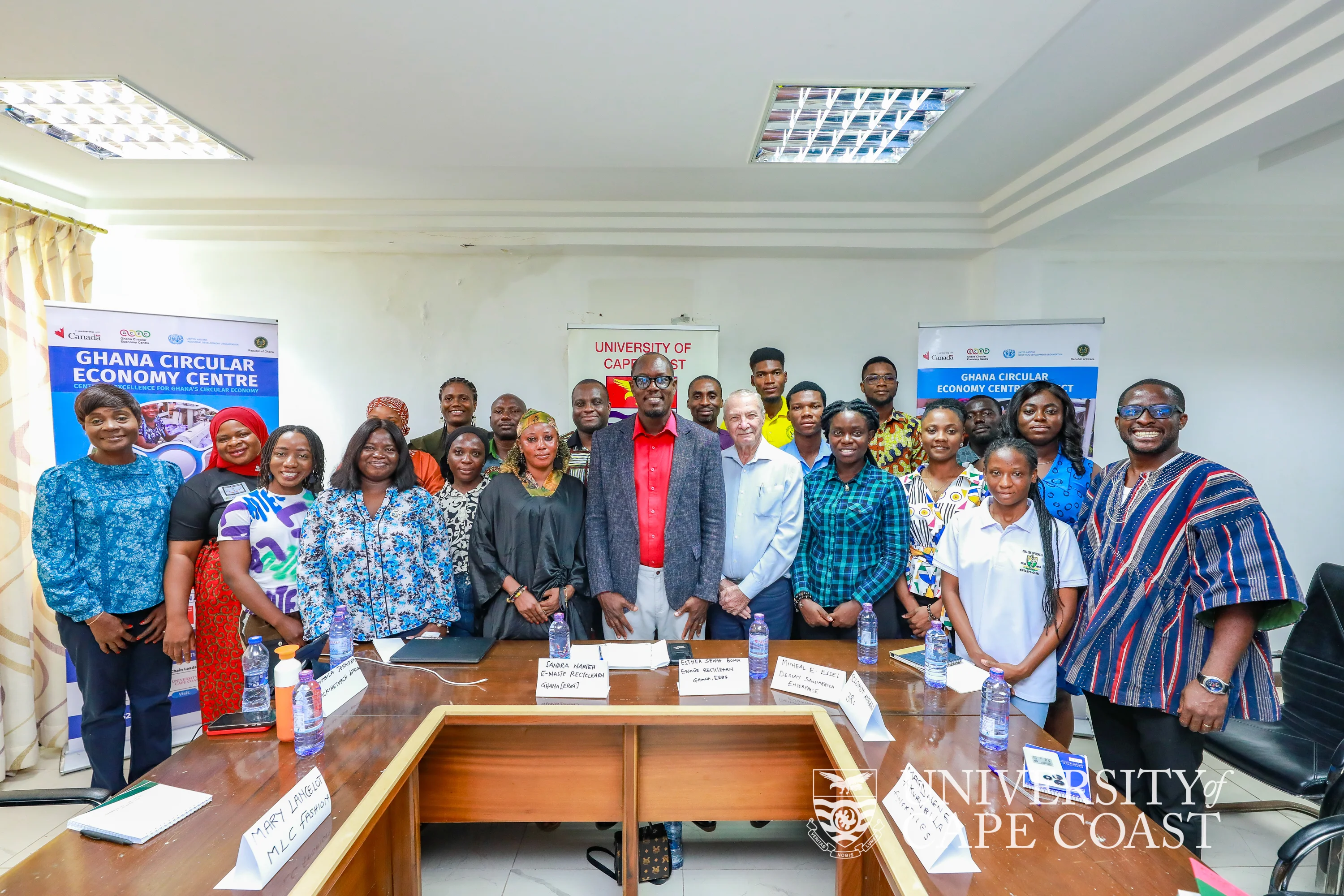
The University of Cape Coast (UCC), through the Ghana Circular Economy Centre (GCEC) Project, has organised a two-day Incubation Bootcamp for selected entrepreneurs participating in the Ghana Circular Economy Centre initiative.
The Bootcamp is designed to strengthen the capacity of emerging businesses operating in the circular economy space, particularly those driving innovation and sustainability in the plastic value chain.
The workshop formed part of activities under the Ghana Circular Economy Centre (GCEC) Project, an initiative led by the United Nations Industrial Development Organisation (UNIDO) in collaboration with the Ministry of Environment, Science and Technology (MEST), with funding support from Global Affairs Canada. The project seeks to accelerate Ghana’s transition towards a circular economy by promoting sustainable production and consumption practices across the plastics, textiles, and agriculture and agro-processing value chains.
As the Plastic Value Chain Lead, the University of Cape Coast is implementing a USD 200,000 Circular Innovation, Incubation, and Enterprise Development Project to support entrepreneurs and innovators developing circular economy solutions in the plastics sector.
The programme is being implemented in partnership with Cape Coast Technical University and City Waste Recycling Limited, leveraging the complementary strengths of academia and industry to foster innovation, enterprise growth, and sustainable business development.
The broader GCEC Project is implemented through a consortium of value chain leads comprising the University of Cape Coast (Plastics Value Chain), Kwame Nkrumah University of Science and Technology (Agriculture and Agro-processing Value Chain), and The Or Foundation (Textiles Value Chain), working collaboratively to advance circular economy solutions and create sustainable livelihood opportunities across Ghana.
Opening the camp, the Project Lead, Professor Daniel Agyapong, who is also the Provost of College of Humanities and Legal Studies, commended the selected entrepreneurs for their interest and commitment to the Ghana Circular Economy Centre initiative.
He urged participants to take the lessons seriously and apply them in their personal and professional lives.
He said such interventions play an important role in addressing youth unemployment.
He encouraged the young people to believe in their abilities and take advantage of the opportunities offered by the programme.
Speaking at the event, Dr. Brandford Bervell, who represented the Director of the Directorate of Research, Innovation and Consultancy, Professor David Teye Doku, noted that sustainability-linked innovative solutions are now essential for business growth, environmental protection and national development.
He commended the incubatees for their commitment to promoting circularity in the plastic value chain and encouraged them to remain focused on transforming waste-related challenges into viable business opportunities.
Dr. Bervell further indicated that the UCC, through DRIC, was well-positioned to support innovation, entrepreneurship and enterprise development. He urged the participants to take advantage of the upcoming UCC Innovation Week as an additional platform to build their businesses, connect with stakeholders and showcase their solutions.
Other project members supporting the Bootcamp include Dr Daniel Ofori, the Project Coordinator, Prof Kwame Anane-Fenin of Cape Coast Technical University, Vivian Ahiayibor and Jurgen Meinel of City Waste Recycling Company Limited, Dr Alex Boadi Dankyi and Dr Akua Tiwaa Buabeng of the Directorate of Research, Innovation and Consultancy. Other facilitators include Prof Rosemond Boohene, Prof Edward Marfo-Yiadom, Dr Peterson Owusu Jnr and Prof Gloria Agyapong of the School of Business, UCC; Ms Benedicta Mensah of the Cape Coast Chamber of Commerce and Industry; Prof Eunice Fay Amissah, Director of CEGRAD; and Dr Osman Light of F-SENSES Ghana.
The Bootcamp features training in circular economy thinking, business modelling, innovation management, branding, governance, financial literacy, investment readiness, environmental and social risk management, gender inclusion and digital tools for enterprise growth. It is expected to support the development of market-ready circular business models while promoting inclusive participation of women, youth and underserved groups in Ghana’s circular economy ecosystem.