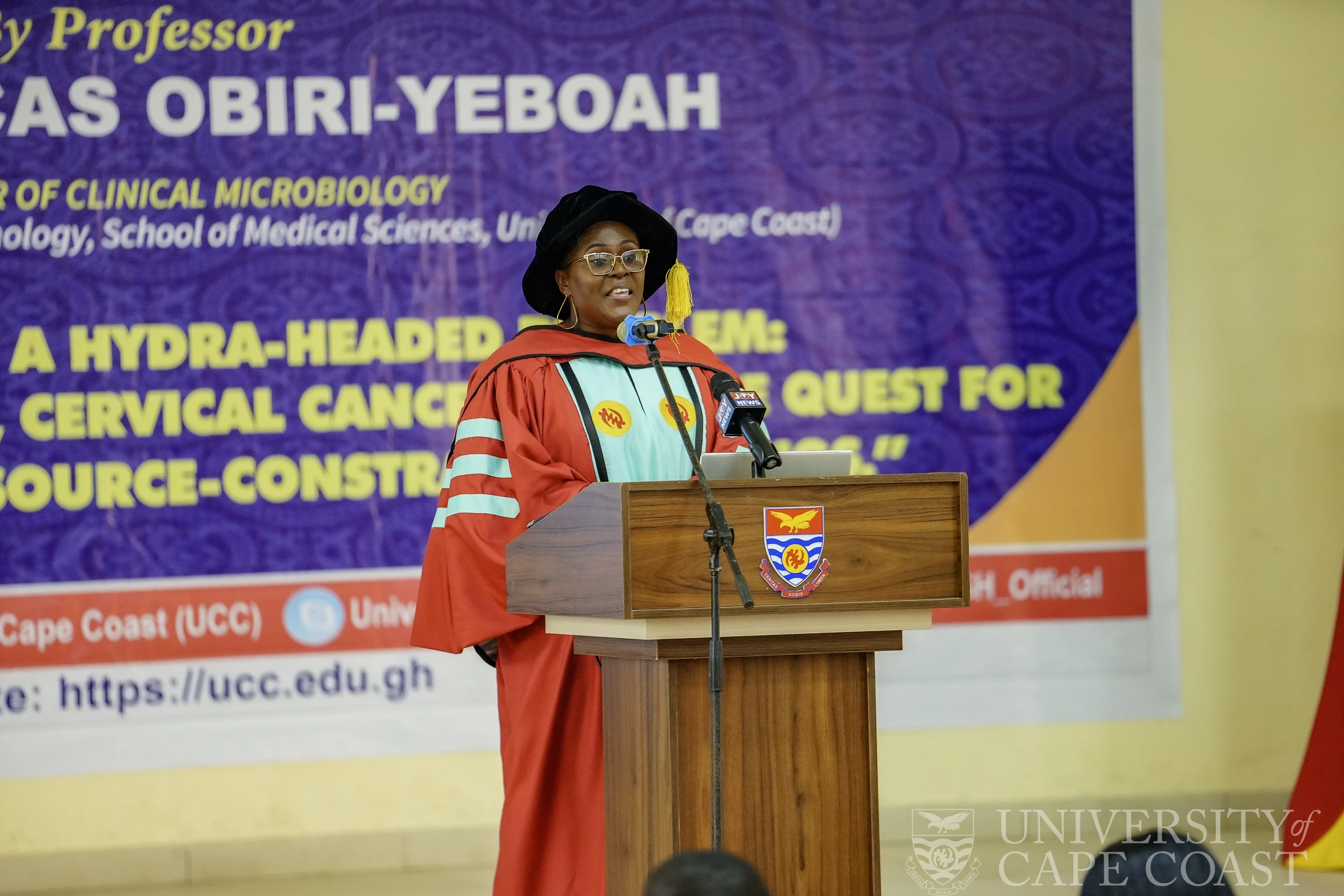
According to her, most cases are diagnosed at advanced stages, when very little could be done to save lives.
Prof. Obiri-Yeboah made these remarks during her inaugural lecture titled, “Confronting a Hydra-Headed Problem: Human Papillomavirus, Cervical Cancer, and the Quest for Elimination in Resource-Constrained Settings.”
Cervical cancer is the fourth most common cancer among women globally and the second most common cancer in Ghana. It also remains a leading cause of cancer-related deaths among women.
The disease is caused by the Human Papillomavirus (HPV), which affects the cervix—the lower part of the uterus. HPV is transmitted through sexual contact and may remain in the cervix for 10 to 15 years without symptoms.
At advanced stages, affected women may experience abnormal vaginal bleeding, bleeding after sex, offensive vaginal discharge, back pain, and weight loss.
Prof. Obiri-Yeboah emphasized that early diagnosis significantly improves treatment outcomes, as intervention can begin before the disease becomes complicated. Depending on the stage, treatment may include surgery (removal of the uterus), radiotherapy, and chemotherapy.
She explained that regular Pap smears and HPV testing are effective in detecting cervical cancer early. She noted that the disease often shows no symptoms in its early stages and may take years before signs appear.
She identified risk factors, including early sexual debut (especially before age 18), having multiple sexual partners, smoking, a family history of cancer, and HIV infection, which weakens the immune system.
She advised women to undergo Pap smear screening every three years and HPV testing every five years if results are negative.
“Women living with HIV have a sixfold higher risk of developing cervical cancer and should begin screening at age 25,” she added.
While cervical cancer is highly preventable, Prof. Obiri-Yeboah noted that low awareness, limited access to vaccination, and the cost of services continue to hinder prevention efforts.
She dismissed fears that screening is painful, stressing that the procedure takes only a few minutes and is painless.
She welcomed the introduction of the HPV vaccine into Ghana’s national immunisation programme, describing it as a major milestone in protecting girls and reducing future cancer incidence. However, she noted that financial barriers still limit vaccine access for many women.
She highlighted the work of her organisation, IPVS Ghana Ambassadors, which has undertaken health advocacy initiatives including mentorship, provision of medical equipment, and continuous professional development. She also emphasized the growing role of Artificial Intelligence and digital innovations in cervical cancer screening.
Prof. Obiri-Yeboah called on Ghanaians to support a national cervical cancer screening programme, describing it as long overdue.
“It is long overdue and it cannot remain something in the pipeline. It needs to be a reality. And if nothing at all, we can start with women living with HIV,” she said.
She urged the media to use their platforms to champion cervical cancer eradication and called on policymakers to move beyond guidelines to actual resource allocation.
Source: Documentation and Information Section-UCC