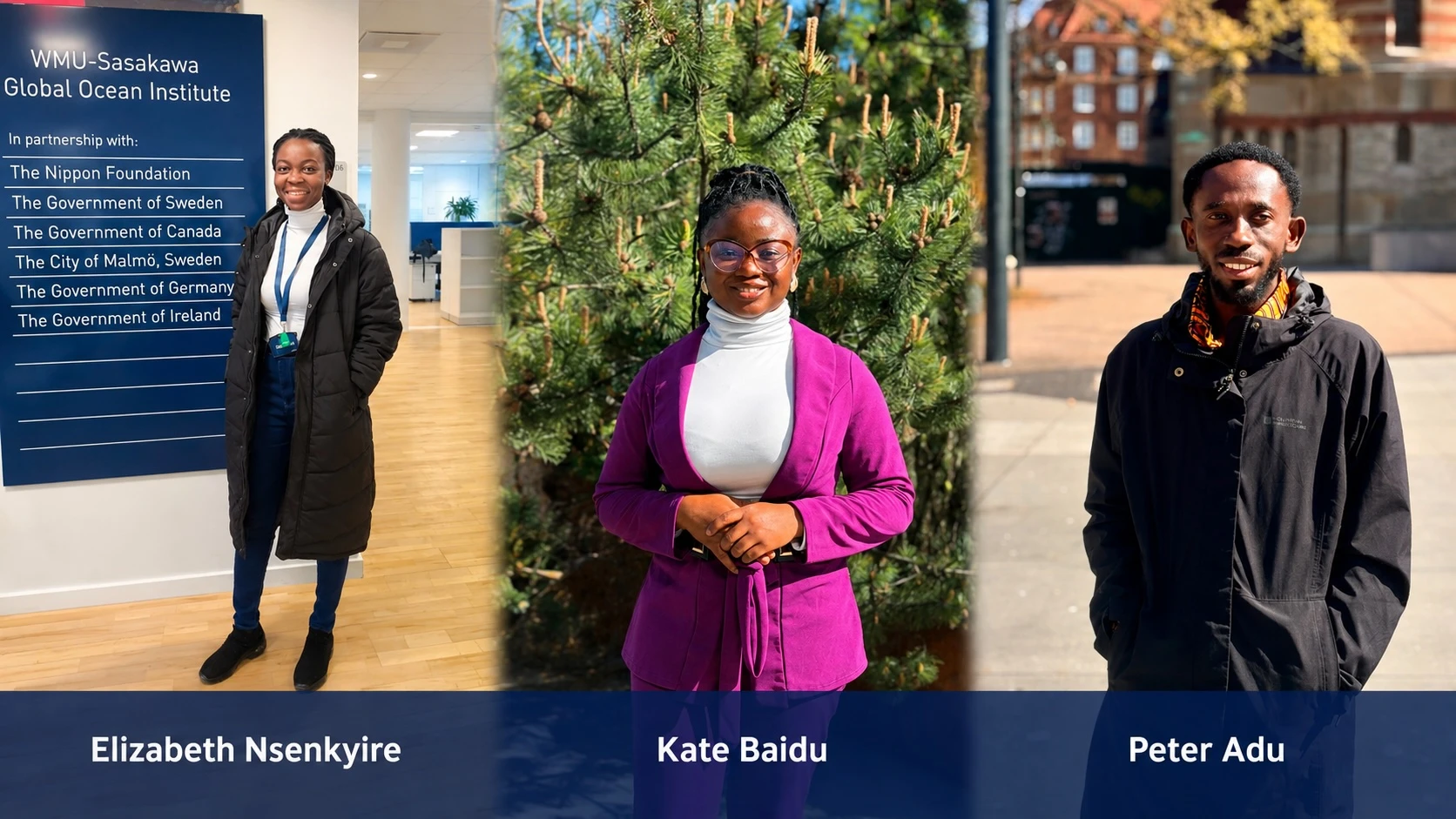
Three postgraduate students pursuing studies in Blue Economy, Governance and Social Resilience at the University of Cape Coast (UCC) have successfully participated in an Erasmus+ exchange programme at the World Maritime University (WMU), Malmö, Sweden.
The opportunity formed part of efforts to enhance their academic and professional competencies in ocean governance, maritime affairs, and sustainable development.
The students, Ms. Kate Baidu, and Mr. Peter Adu, both MPhil candidate, and Ms. Elizabeth Nsenkyire, a PhD candidate, described the exchange programme as a transformative experience that broadened their understanding of global ocean governance and sustainability.
Sharing their experiences, the students indicated that studying courses in global ocean governance, maritime diplomacy, and international negotiation equipped them with critical thinking, analytical, and problem-solving skills. They noted that practical learning activities, including negotiation exercises, case studies, and mediation role-plays, strengthened their understanding of international legal frameworks such as the United Nations Convention on the Law of the Sea (UNCLOS) and the Biodiversity Beyond National Jurisdiction (BBNJ) Agreement.
According to them, the rigorous academic culture at WMU helped sharpen their discipline and time management abilities, enabling them to meet academic expectations and project requirements effectively.
The students also underscored the benefits of studying in a diverse international environment, which brought together participants from countries such as Cape Verde, Thailand, Indonesia, the Philippines, Antigua and Barbuda, Nigeria, and France. They noted that interacting with colleagues from different cultural and professional backgrounds enriched their learning experience, broadened their global perspectives, and reinforced the need to amplify African voices in international debates on fisheries governance, climate change, and the sustainable management of ocean resources.
They also observed that Sweden's strong commitment to sustainability and marine environmental protection provided practical lessons on how effective governance systems could support long-term development. The experience, they noted, inspired them to reflect on ways similar approaches could be adapted to address Ghana's environmental and developmental needs.
Reflecting on the overall impact of the exchange programme, the students stated that the experience had expanded their global outlook and strengthened their commitment to contributing to international discussions on maritime development, coastal environmental management, and community resilience.
They expressed confidence that the knowledge acquired, coupled with the professional networks established during the programme, would create new academic and career opportunities and enable them to contribute meaningfully to national and regional efforts aimed at advancing ocean governance and sustainability.
The students acknowledged that the strong academic foundation they received through the Blue Economy, Governance and Social Resilience programme at UCC played a significant role in their success during the exchange programme. They explained that the knowledge and skills acquired through their studies enabled them to engage confidently in discussions, practical exercises, and collaborative learning activities at WMU.
They encouraged prospective postgraduate students with an interest in ocean governance, sustainability, and maritime development to apply for the Blue Economy, Governance and Social Resilience programme at UCC. According to them, the programme offers unique opportunities for international exposure, academic growth, and professional networking through initiatives such as the Erasmus+ exchange programme.